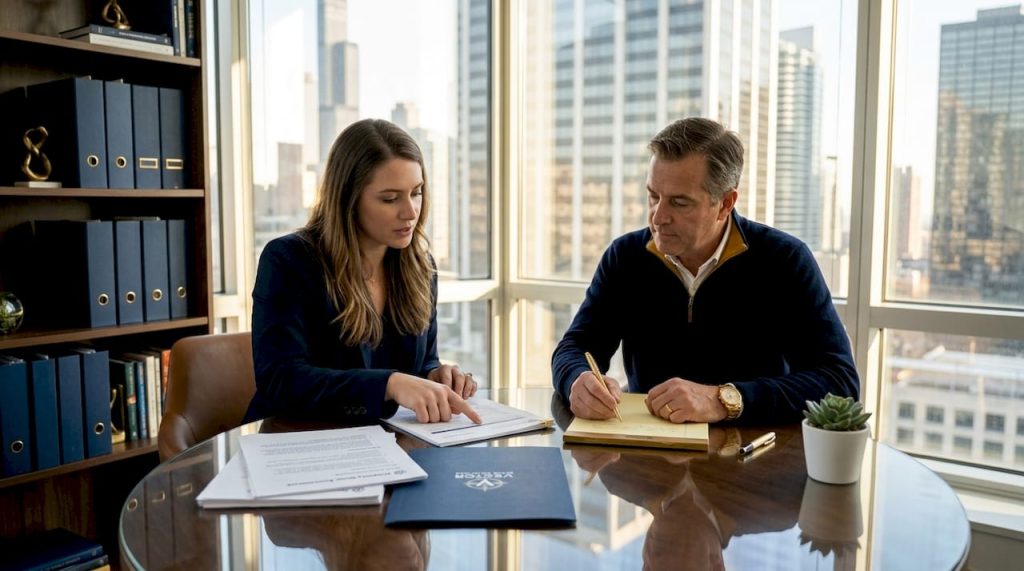
When your commercial property sustains damage, the insurance claim process rarely goes smoothly. Low estimates, disputed scope, and delayed responses from your carrier are common frustrations. Knowing when and how to hire a public adjuster for commercial property can shift the outcome significantly. A licensed public adjuster works exclusively for you, the policyholder, not the insurer. This article walks you through what public adjusters do, how to prepare before hiring one, the step-by-step claim process, pitfalls to avoid, and how to verify your settlement is fair.
Table of Contents
- Key takeaways
- Why hire a public adjuster for commercial property
- What to prepare before hiring a public adjuster
- The step-by-step process of working with a public adjuster
- Common mistakes when hiring a commercial adjuster
- Verifying your claim has been fairly settled
- My honest take on commercial public adjusting
- Let Vectorclaimsolutions review your commercial claim
- FAQ
Key takeaways
| Point | Details |
|---|---|
| Public adjusters work for you | They represent the policyholder exclusively, not the insurance carrier, throughout the entire claim. |
| Documentation drives outcomes | Thorough photos, receipts, and policy records directly determine the strength of your negotiated settlement. |
| Licensing verification is critical | Each state regulates public adjuster qualifications; always confirm a valid license before signing any contract. |
| Fees are contingency-based | Most public adjusters charge 5% to 20% of the settled amount, with state-specific caps that vary by situation. |
| Early engagement improves results | Bringing in a licensed adjuster before submitting your claim typically produces stronger documentation and better payouts. |
Why hire a public adjuster for commercial property
A public adjuster is a licensed professional hired exclusively by the policyholder to document damage, interpret policy language, prepare the claim, and negotiate directly with the insurer. They are entirely independent from the insurance company’s adjusters, who work to protect the carrier’s interests. That distinction matters more on commercial claims than almost anywhere else.
Commercial property claims often extend well beyond physical structure damage. They can include business personal property, equipment inventories, tenant improvements, and business interruption losses. Each of these coverage categories has its own documentation requirements, valuation methods, and policy conditions. Managing all of them simultaneously while trying to keep your business operating is genuinely difficult.
A skilled public adjuster handles the following on your behalf:
- Damage documentation: Systematic photography, measurements, and written descriptions tied to specific policy coverages
- Policy interpretation: Reading and applying your commercial policy language to every line item of loss
- Claim preparation: Assembling a complete, organized claim packet that supports your stated losses with evidence
- Insurer negotiation: Meeting with the insurance company’s adjusters, responding to coverage disputes, and pushing back on undervalued line items
- Business interruption analysis: Calculating lost income and extra expenses attributable to the covered loss event
Commercial claims require more sophisticated documentation than residential claims because of multi-structure losses, equipment inventories, and business interruption components. That complexity is exactly where an experienced public adjuster adds the most value.
Pro Tip: Ask any public adjuster you consider hiring to show you a sample claim packet they have prepared. The quality of that document tells you more than any sales conversation will.
What to prepare before hiring a public adjuster
The more organized you are before your first meeting with a public adjuster, the faster and more effectively they can get to work. Your preparation directly affects how quickly the claim moves forward and how complete the final documentation will be.
Here is a checklist of what to gather before your initial consultation:
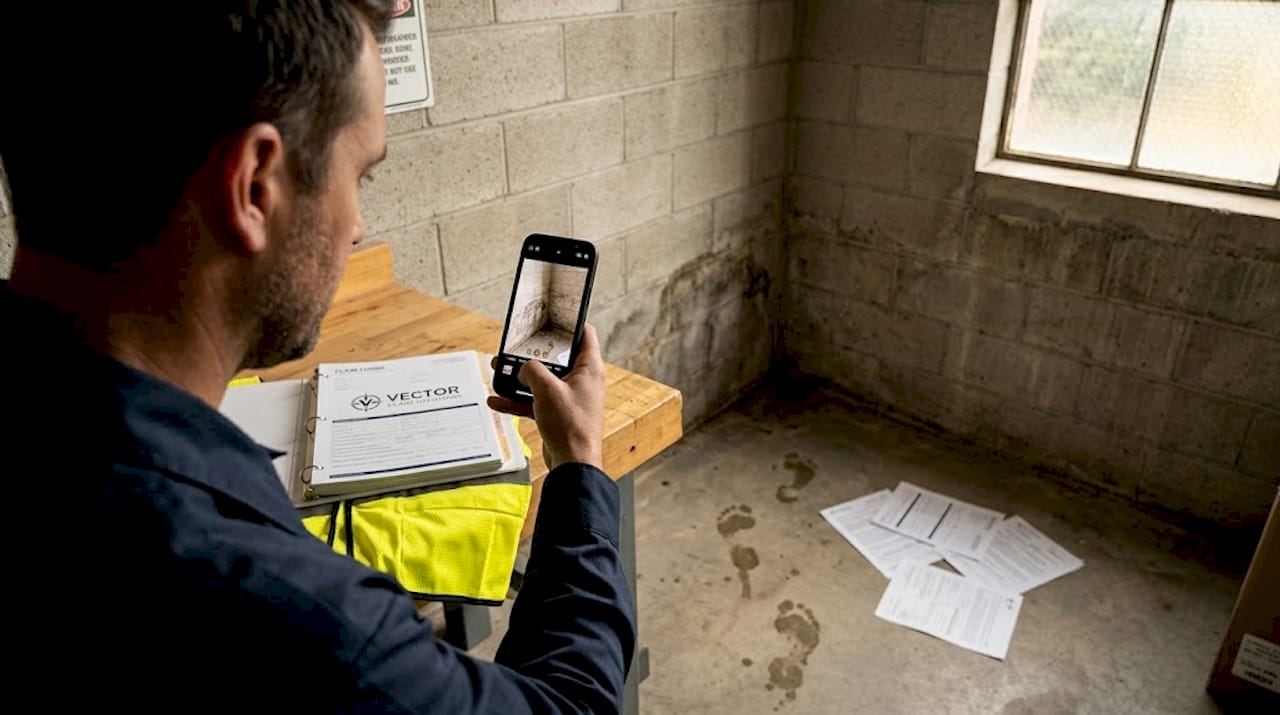
- Photographs and videos of all visible damage, taken as soon as it is safe to access the property
- Your current commercial property insurance policy, including all endorsements and declarations pages
- Prior inspection reports, maintenance records, or appraisals for the damaged property
- Receipts or invoices for any emergency repairs or mitigation work already completed
- A written log of dates, times, and descriptions of all damage-related events and communications with your carrier
- Inventory records for damaged equipment or business personal property, with purchase dates and values where possible
Prompt reporting and thorough documentation facilitate faster and more accurate claim assessments. Protecting your property from further damage and keeping records of every mitigation step is also a policy requirement in most commercial policies. Failing to do so can give the insurer grounds to reduce your payout.
The table below shows what documentation serves which purpose in the claims process:
| Document type | Primary purpose in the claim |
|---|---|
| Damage photos and videos | Establishes scope and condition at the time of loss |
| Policy and endorsements | Defines what is and is not covered under your specific contract |
| Repair invoices and receipts | Supports actual cash value and replacement cost calculations |
| Maintenance and inspection records | Demonstrates pre-loss condition and reduces depreciation disputes |
| Business interruption records | Quantifies lost income and extra operating expenses |
| Communications log | Preserves a factual timeline for any coverage disputes |
Pro Tip: Before signing any contract with a public adjuster, verify their state license. There is no federal license. Each state issues its own, and requirements and fee caps differ considerably.
The step-by-step process of working with a public adjuster
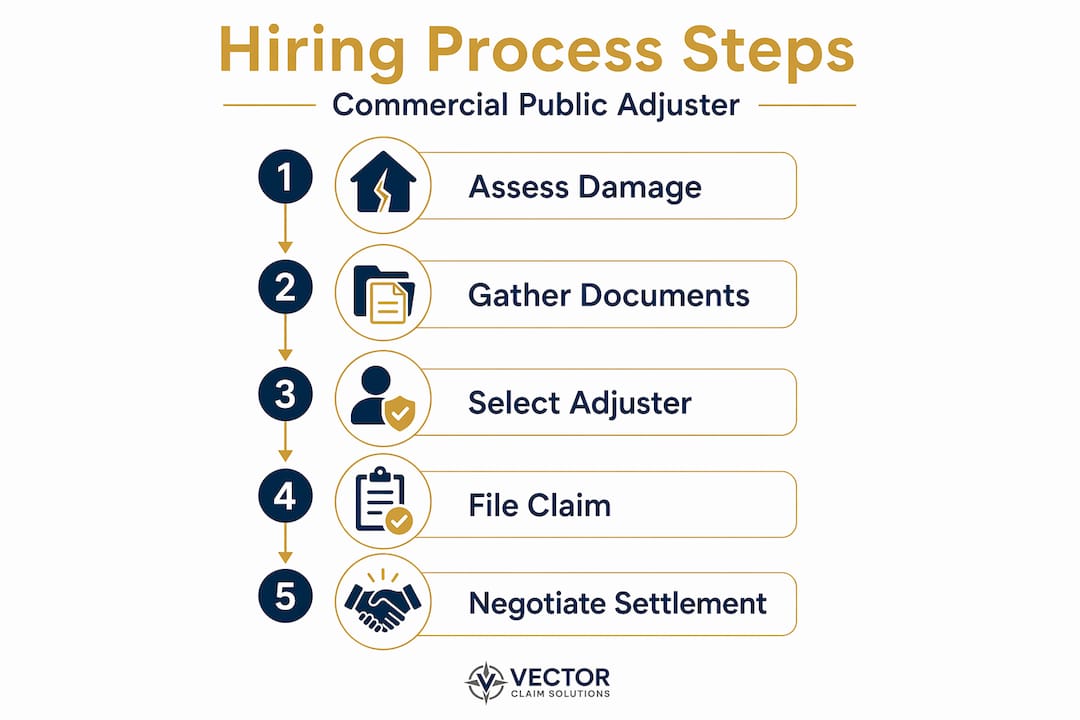
Understanding the full workflow helps you stay engaged at each phase and know what to expect from your public adjuster throughout the claim.
-
Initial consultation. Your public adjuster reviews your policy, the reported damage, and your carrier’s initial response if one exists. They evaluate the claim’s merits, discuss their fee structure, and outline what the process will look like. Public adjusters typically charge a contingent fee between 5% and 20%, depending on state law and claim complexity.
-
Comprehensive damage inspection. The adjuster conducts a thorough on-site inspection, often with a scope that goes beyond what the insurer’s adjuster documented. They photograph, measure, and record every component of the loss, including items the carrier may have missed or excluded.
-
Claim packet preparation. Using the inspection data and your policy language, the adjuster assembles a negotiation-ready claim file that connects documented damages to specific policy provisions. This is the foundation of your negotiation position.
-
Submission and response. The adjuster submits or supplements the claim with the carrier. The insurer’s adjuster responds, and your public adjuster reviews that response for scope gaps, incorrect depreciation, or coverage denials that need to be addressed.
-
Negotiation. Your adjuster engages directly with the insurance company’s team, presenting evidence and policy arguments to support a higher or more complete settlement. This phase can involve multiple rounds of back-and-forth before resolution.
-
Settlement finalization. Once an agreed settlement amount is reached, your adjuster reviews the final payment documentation with you and confirms that all covered losses are accounted for before you sign off.
The table below shows how a public adjuster’s approach differs from working through a claim on your own:
| Aspect | Without a public adjuster | With a public adjuster |
|---|---|---|
| Damage scope | Based on insurer’s inspection | Independent, construction-level assessment |
| Policy interpretation | Carrier’s interpretation | Policyholder-focused reading |
| Claim documentation | Whatever you submit | Organized, negotiation-ready packet |
| Settlement negotiation | You vs. the carrier | Licensed advocate negotiating for you |
| Overlooked damages | Frequently missed | Systematically identified and documented |
Common mistakes when hiring a commercial adjuster
Working with the right public adjuster produces significantly better outcomes. Working with the wrong one can make a difficult claim much worse. These are the mistakes to avoid.
- Hiring an unlicensed individual. Unlicensed contractors performing claim negotiation or preparation create compliance issues and weaken your ability to dispute underpayments. Only a licensed public adjuster has the legal authority to negotiate on your behalf in most states.
- Skipping the credential check. Misappropriation by unscrupulous adjusters has resulted in policyholders losing substantial funds. Always verify credentials, check licensing with your state’s insurance department, and ask for references from prior commercial clients.
- Not reviewing the contract. Fee percentage, scope of work, and termination rights should all be clearly defined before you sign anything. Some contracts lock you in even if you are dissatisfied with performance.
- Letting documentation fall behind. Your adjuster can only work with the evidence you and they create. If you delay providing policy documents, receipts, or access for inspection, the claim timeline slows and gaps can appear in the file.
- Going silent during the process. Stay in regular contact with your adjuster. Commercial claims move through multiple stages, and your input on business interruption figures, equipment values, and lease obligations is often irreplaceable.
The most common reason commercial claims settle below actual loss value is not bad policy language. It is incomplete documentation. Every missing photo, every unrecorded repair receipt, and every undocumented equipment loss is money left on the table.
Pro Tip: If a contractor offers to handle your insurance claim as part of their repair bid, that is a red flag. Licensed public adjusters hold the exclusive legal authority to negotiate claims in most states. Contractors cannot legally fulfill that role.
Verifying your claim has been fairly settled
Once a settlement offer is on the table, your work is not finished. Reviewing the final numbers carefully is a critical step that commercial property owners sometimes skip out of exhaustion or urgency to move forward.
Here is what to check before accepting any settlement:
- Compare the settlement scope to your original loss. Every damaged item that was documented should appear in the final settlement breakdown. If a line item is missing or has been deprecated out of the payout, ask for a written explanation.
- Review depreciation calculations. Insurers often apply depreciation to reduce initial payouts. Your policy may entitle you to recover that depreciation upon completion of repairs. Confirm whether your policy is actual cash value or replacement cost coverage.
- Request a written breakdown. A fair, well-negotiated settlement is supported by a detailed line-by-line estimate. If the carrier offers a lump sum without explanation, push for itemization.
- Retain all paperwork. Keep every document related to the claim, including the original policy, all correspondence, the adjuster’s report, and the final settlement agreement. You may need these if a dispute arises later.
- Consider a second opinion on low offers. If you believe the settlement does not cover your actual losses, you have the right to request a claim process review or pursue appraisal under your policy’s dispute resolution provisions. For claims involving potential bad faith denial, consulting with civil litigation attorneys is worth considering.
Early engagement of a licensed public adjuster consistently produces stronger documentation and a better negotiation position from the start. The further into the process you wait, the harder it becomes to correct documentation gaps.
My honest take on commercial public adjusting
I have worked through enough large-loss commercial claims to know that the average commercial property owner enters the process at a significant disadvantage. The insurance carrier’s adjuster has handled thousands of claims. Most property owners have handled one or two, if any, and they are doing it while managing a damaged property and trying to keep their business running.
What I have found to be true, consistently, is that documentation quality is the single greatest predictor of claim outcomes. Not the size of the loss. Not the policy limits. The quality of the evidence presented. A well-prepared claim documentation packet that ties measured damages to specific policy language is far harder for a carrier to dispute than a vague written statement accompanied by a few photos.
I have also seen property owners hesitate to hire a public adjuster because of the fee structure. The contingency fee feels like a cost. What they miss is that the fee is paid from a larger settlement, not from their own pocket upfront. In most cases, the increase in settlement value exceeds the fee by a meaningful margin.
The one piece of advice I give to every commercial property owner before they start: engage a licensed adjuster before you know if you need the signs for a public adjuster, not after the carrier sends a low offer and the window to strengthen documentation has narrowed. Earlier engagement means better outcomes. That is not a sales pitch. That is what the data consistently shows.
— Vector
Let Vectorclaimsolutions review your commercial claim
If your commercial property has sustained damage and you are not confident your current estimate reflects your actual loss, a professional review costs you nothing upfront. At Vectorclaimsolutions, we work exclusively on the policyholder’s side of every claim, operating across Nebraska, Iowa, Colorado, Texas, and Florida.
We specialize in identifying underpaid, denied, or improperly scoped commercial claims and correcting them through construction-level analysis and direct carrier negotiation. Whether you are dealing with a storm loss, hail damage, water intrusion, or a complex multi-structure event, our team prepares claim files built to support maximum recovery. Start with a commercial claim process review to understand what your policy actually covers and where your current estimate may fall short. You can also visit Vectorclaimsolutions to learn more about our approach and request a consultation with no obligation.
FAQ
What does a public adjuster do for commercial property claims?
A public adjuster documents all covered damages, interprets your commercial policy, prepares a complete claim packet, and negotiates with your insurer on your behalf. They work exclusively for you, not the insurance carrier.
How much does it cost to hire a commercial adjuster?
Public adjusters charge a contingent fee, typically between 5% and 20% of the final settled amount, with state-specific caps that vary. Florida, for example, caps fees at 20% for standard claims and 10% during declared emergencies.
When should I hire a public adjuster after property damage?
The earlier the better. Early engagement allows the adjuster to document conditions before repairs begin and prepare a claim file that accurately reflects the full scope of loss from the start.
How do I verify a public adjuster is properly licensed?
Contact your state’s department of insurance directly to confirm active licensure. State licensing is required in most states and there is no federal license, so verification must be done state by state.
Can I dispute a commercial insurance settlement after it has been paid?
Yes, in many cases. Review your policy for appraisal or dispute resolution clauses. If you believe your claim was underpaid, requesting a second opinion or claim review is a practical starting point before pursuing formal dispute options.