

Filing a storm damage claim can feel like the hardest part is already behind you. But for many homeowners and commercial property owners in Nebraska, Iowa, Colorado, Texas, and Florida, the real complexity begins after they dial that first call to their insurer. What follows isn’t a simple payout process. It’s a structured investigation that can take weeks, require detailed documentation, and sometimes produce outcomes that leave policyholders feeling blindsided. This guide walks you through exactly how insurance claim investigations work, what insurers look for at each stage, and what you can do to protect your interests from day one.
Table of Contents
- What is an insurance claim investigation?
- Key steps in the insurance investigation process
- How insurers handle unclear cases (“the grey zone”)
- Special requirements for storm-related claims in Florida
- What you can do to make your claim smoother
- Hard truths about insurance claim investigations: What most guides won’t tell you
- How expert help can change the process
- Frequently asked questions
Key Takeaways
| Point | Details |
|---|---|
| Investigations verify losses | Insurance claim investigations are designed to check losses, coverage, and cause—not to automatically pay out every claim. |
| Documentation is critical | Providing photos, receipts, and clear timelines helps speed up your claim and avoid delays. |
| ‘Grey zone’ claims face extra scrutiny | When stories or paperwork are unclear, expect more questions and document requests from your insurer. |
| Florida has strict deadlines | Storm claims in Florida must follow mandatory investigation and payout timelines set by state law. |
| Professional help is available | Public adjusters can help ensure evidence is presented effectively and you receive a fair settlement. |
What is an insurance claim investigation?
Many policyholders assume that filing a claim and receiving payment are nearly automatic steps. In reality, every claim triggers a formal review process designed to verify what happened, confirm the cause of damage, and determine whether your policy actually covers the loss.
Insurance claim investigations are a structured process used to verify what happened, what damage occurred, and whether the loss is covered. They typically involve documentation review, communications, and, for property losses, inspections and field investigation.
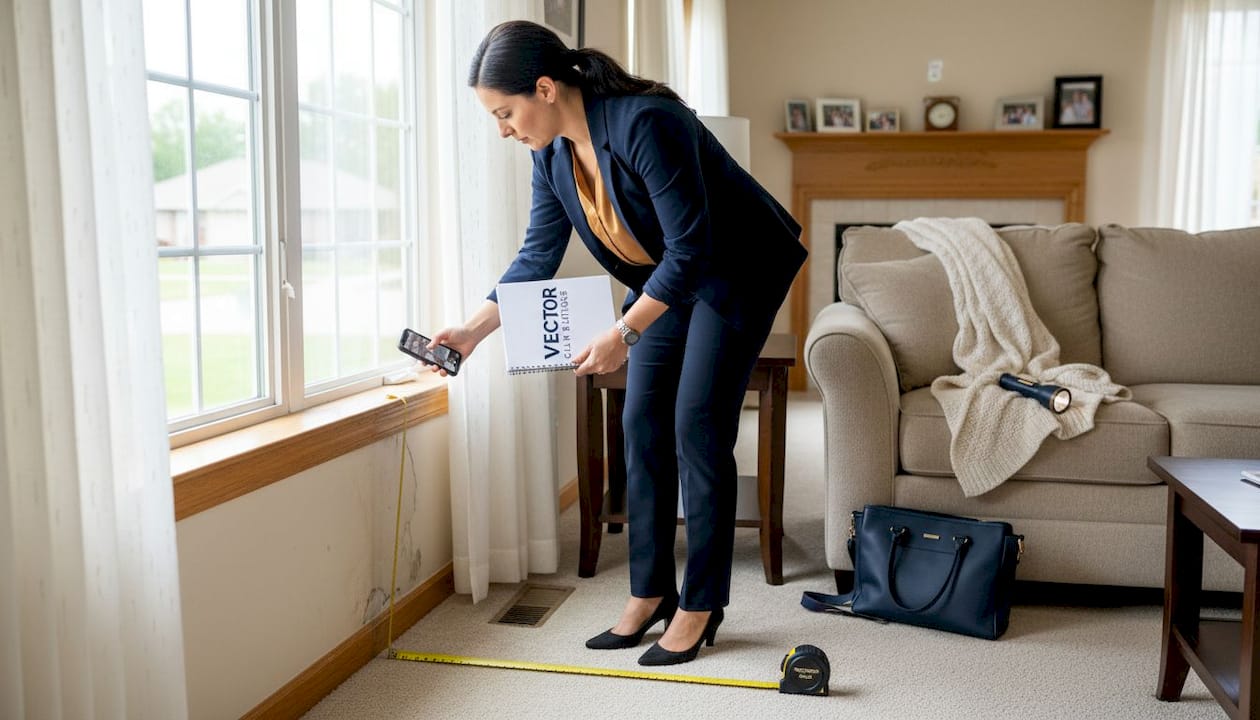
The investigation isn’t designed to deny your claim outright. Its purpose is to gather enough evidence to make an informed, defensible decision. Think of it as the insurer building a case file for your loss. That file needs to contain photos of the damage, records of the storm event, receipts for emergency repairs, statements from you, and often the analysis of a licensed adjuster who visits your property in person.
Adjusters are trained to identify both covered damage and signs of issues that may not be covered, such as pre-existing deterioration, deferred maintenance, or damage caused by something outside your policy’s scope. When you’re navigating property insurance claims, understanding this distinction early can prevent a lot of frustration later.
Key elements adjusters examine during an investigation include:
- Photos and videos of all damaged areas, ideally taken immediately after the storm
- Dates and weather event records to confirm when the storm occurred and what it produced
- Receipts and invoices for any emergency mitigation work already completed
- Maintenance records that demonstrate the property was in reasonable condition before the loss
- Your policy documents, including coverage limits, exclusions, and any endorsements
Key steps in the insurance investigation process
With an understanding of what an investigation sets out to do, let’s walk through the main steps you’ll experience during the process.
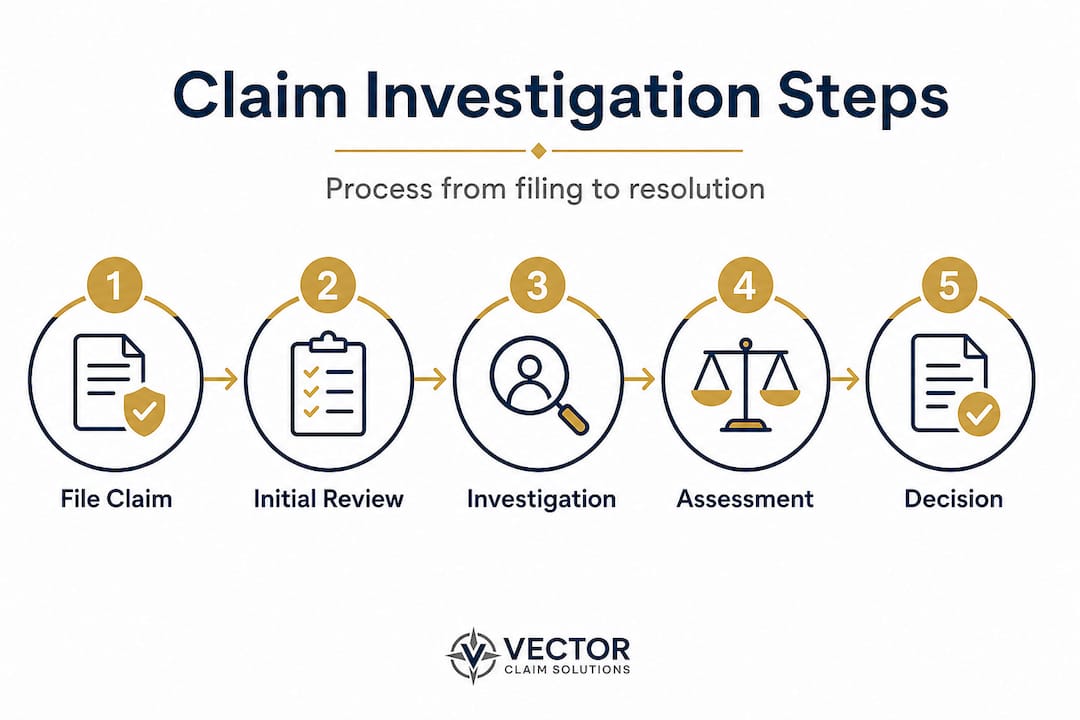
A typical storm damage investigation moves through five fairly predictable stages, though the pace and complexity vary depending on your state, your insurer, and the nature of the damage itself.
-
Adjuster assignment. Once you file your claim, your insurer assigns a staff adjuster or an independent adjuster to your file. This person becomes your primary point of contact and is responsible for evaluating your loss.
-
Initial information gathering. The adjuster reviews your policy, your submitted documents, and any prior claim history before doing anything else. This step establishes a baseline for what coverage exists and flags any potential exclusions.
-
Field investigation and scope of loss. Adjusters build a scope of loss, which is a detailed, room-by-room or area-by-area breakdown that includes measurements, repair descriptions, and cost estimates. This is the document that ultimately drives your settlement offer, which is the final amount the insurer offers to resolve your claim.
-
Recorded statement. Your insurer will likely request a formal recorded statement from you about the loss. This is standard practice, but it matters. What you say, and how you say it, becomes part of the official record.
-
Expert input or escalation. For large or complex losses, insurers may bring in specialists like engineers, roofing consultants, or forensic meteorologists to weigh in on cause and origin. This is more common in commercial claims or cases involving disputed damage.
Following the residential claims process can help homeowners understand which stage they’re in at any given moment, reducing the uncertainty that so often adds stress to an already difficult situation.
Pro Tip: Keep a running folder of all photos, written communication, and receipts tied to your claim. Organization at this stage can significantly reduce delays and disputes later. For water-related events, strong evidence for water damage claims can be the deciding factor in a disputed scope of loss.
How insurers handle unclear cases (“the grey zone”)
But what if your claim isn’t straightforward? Here’s how the investigation process changes when insurers face unclear information.
Not every claim arrives with clean documentation, a well-defined storm date, and an obvious cause. Some claims fall into what industry professionals call the “grey zone,” a term for cases where the narrative or evidence doesn’t fully align. These claims receive a different, more intensive level of scrutiny.
When the claim narrative or paper trail is ambiguous, insurer investigators may go beyond the incident itself to review policy history and documentary patterns, then request additional evidence before making a determination.
What does that look like in practice? An insurer might notice that your coverage limits were recently increased shortly before a large claim. Or they may find inconsistencies between your recorded statement and the date on your mitigation receipt. These aren’t automatic fraud accusations, but they do trigger deeper review.
| Factor | Straightforward claim | Grey zone claim |
|---|---|---|
| Documentation quality | Complete, dated, consistent | Missing dates, gaps in timeline |
| Number of interviews | One recorded statement | Multiple follow-up interviews |
| Documents requested | Policy, photos, basic receipts | Bank records, prior claims, contractor history |
| Typical timeframe | 30 to 60 days | 60 to 120+ days |
| Expert involvement | Rare | Common (engineers, consultants) |
| Policy history review | Standard | Detailed, multi-year review |
The table above illustrates how significantly the scope of an investigation can expand once a claim enters the grey zone. For property owners investigating unclear commercial claims, this can be especially disruptive to business operations.
Pro Tip: Consistency matters more than perfection. If your records aren’t complete, document what you know now, be honest about gaps, and don’t speculate. A straightforward, consistent account of the loss is far more useful than a polished story that doesn’t hold up under scrutiny.
Special requirements for storm-related claims in Florida
Next, some states add extra layers to the process. Florida property owners should be aware of these legally mandated steps to safeguard their claim rights.
Florida has some of the most consumer-protective insurance statutes in the country, and they apply directly to how storm damage claims must be investigated. If you own property in Florida, knowing these deadlines gives you real leverage.
Statutory timelines Florida insurers must follow:
- Within 14 days: Insurer must acknowledge receipt of the claim in writing
- Within 14 days: Insurer must begin the investigation process
- Within 90 days: Insurer must pay, deny, or issue a partial payment on the claim
- Immediately upon filing: Insurer must provide you with the Homeowner Claims Bill of Rights
Key statistic: If the insurer misses the 90-day payment deadline, interest accrues on the unpaid claim amount, creating a financial incentive for carriers to move quickly and a financial remedy for you if they don’t.
| Requirement | Florida statute timeline |
|---|---|
| Acknowledge the claim | Within 14 days of filing |
| Begin the investigation | Within 14 days of acknowledgment |
| Pay, deny, or partially pay | Within 90 days of receiving claim |
| Provide Bill of Rights | At time of claim filing |
| Interest on late payment | Accrues after 90-day deadline |
What makes Florida different from Nebraska, Iowa, Colorado, or Texas is the explicit statutory structure around these timelines. Other states have general good faith requirements, but Florida’s rules are codified with penalties attached. If you’re a Florida policyholder and your insurer hasn’t acknowledged your claim after two weeks, that’s not normal and it’s worth addressing directly.
Keep a copy of the Homeowner Claims Bill of Rights your insurer provides. It outlines your rights throughout the process, including the right to have your claim reopened if you discover additional damage within three years of the date of loss.
What you can do to make your claim smoother
So with all this in mind, what can you as a policyholder actually do to improve your investigation outcome?
The good news is that the actions most likely to move your claim forward are things you can start doing right now. None of them require legal expertise. They require organization, consistency, and prompt follow-through.
- Take dated photos and video immediately. Capture all damage from multiple angles before any cleanup or repair work begins. If emergency mitigation is already underway, document what was done and why.
- Keep all receipts and invoices. This includes emergency tarping, water extraction, temporary boarding, and any materials you purchased for immediate protection of the property.
- Respond to insurer requests promptly. Delays on your end can extend the investigation timeline significantly. When the adjuster asks for a document, provide it as soon as reasonably possible.
- Track every communication. Write down the date, time, and content of every phone call with your insurer, adjuster, or contractor. Follow up verbal conversations with a brief confirming email.
- Avoid speculating in statements. Stick to what you observed and what you know. If you’re unsure about a date or detail, say so rather than guessing.
The investigation process rewards policyholders who treat it like a business transaction, one that requires documentation, clear communication, and timely responses.
For claims involving water damage, solid records of proving water damage are essential because water losses are among the most disputed claim types, especially when the origin or timeline is questioned.
Pro Tip: Start a claim journal the day you file. Whether it’s a notebook or a shared digital document, record every interaction, every document submitted, and every deadline. This simple habit has resolved countless disputes that would otherwise have dragged on for months.
Hard truths about insurance claim investigations: What most guides won’t tell you
Now that you know the mechanics, let’s cut through the polite talk and get real about what property owners actually experience during investigations.
Most guides present the claims process as neutral and orderly. The reality is more complicated. Investigations aren’t inherently adversarial, but they operate in a system where the insurer controls the timeline, the scope, and the first settlement offer. That asymmetry matters.
Here’s what we’ve seen time and again across our work in Nebraska, Iowa, Colorado, Texas, and Florida: policyholders who assume the adjuster will find everything wrong with their property are almost always disappointed. Adjusters are thorough, but they’re working from a scope of loss they build during a single site visit. Damage that isn’t visible, accessible, or documented can easily be missed or undervalued.
The more difficult reality is that when claims enter contested territory, insurers may treat the investigation as more than a single incident by reviewing policy history and coverage changes over time, then escalating document requests when the narrative doesn’t line up. Most honest policyholders don’t expect this level of scrutiny and aren’t prepared for it.
Our honest advice: treat your claim as something you need to actively manage, not something that will manage itself. The policyholders who navigate insurance claim realities most successfully are the ones who document everything, respond promptly, and know when to ask for help. They don’t wait to see if the settlement offer feels fair. They compare it against actual repair costs and push back when the numbers don’t add up.
Documentation isn’t just a formality. In a contested or grey zone investigation, your organized records can be the difference between a fair settlement and a significantly underpaid one.
How expert help can change the process
If you’re unsure or overwhelmed by the investigation process, consider seeking professional support aimed at maximizing fair claim outcomes.
Storm damage investigations can move fast or grind slowly, and either scenario can feel like you’re flying blind without experience on your side. A licensed public adjuster works exclusively for you, not the insurance company, handling documentation, meeting deadlines, interpreting policy language, and negotiating on your behalf.
At Vector Claim Solutions, we specialize in the exact situations where policyholders feel stuck: underpaid settlements, denied claims, incomplete scopes of loss, and claims that have been sitting unresolved for too long. Whether you’re dealing with storm damage claims after a hail event in Colorado or a hurricane in Florida, or you need guidance on the full range of claim types we handle, we bring construction-level analysis and structured negotiation to every file. Homeowners can explore exactly how we support public adjusters for homes to get a clear picture of what professional advocacy looks like in practice.
Frequently asked questions
How long does a typical insurance claim investigation take?
Timelines vary by state and claim complexity, but in Florida, insurers are legally required to pay or deny within 90 days for storm-related claims. In other states, major property claims can take several weeks to several months depending on documentation quality and dispute levels.
Do I need to be present for the insurance adjuster’s inspection?
It’s strongly recommended. Being present lets you point out all areas of damage, answer the adjuster’s questions accurately, and ensure nothing significant is overlooked during the site visit.
What happens if my documentation isn’t complete?
Incomplete or inconsistent paperwork can delay your claim significantly or push it into the grey zone for deeper review, since ambiguous paper trails trigger additional investigation steps and document requests from the insurer.
Can an insurance claim be denied after the investigation?
Yes. If the investigation concludes that the cause of damage isn’t covered by your policy, or if there are meaningful discrepancies in the evidence you provided, the insurer can partially or fully deny the claim.
What are my options if I disagree with the insurer’s determination?
You can request a reinspection, submit additional documentation, invoke your policy’s appraisal clause if one exists, or bring in a licensed public adjuster or attorney to advocate for a fair resolution on your behalf.