

Most homeowners assume their standard policy covers hail damage automatically. That assumption can cost thousands of dollars when a claim gets denied or partially paid. Understanding what is a hail damage exclusion policy means knowing exactly where your coverage stops, which components might be excluded, and why insurers write these clauses into contracts in the first place. This article breaks down how hail damage exclusion policies work, what cosmetic damage exclusions actually mean in practice, and what you can do to protect your claim before the next storm season arrives.
Table of Contents
- Key takeaways
- What is a hail damage exclusion policy and how it works
- Understanding cosmetic damage exclusions
- Key policy elements affecting hail coverage
- Steps to take when your policy includes a hail exclusion
- Common misconceptions about hail damage coverage
- My perspective on hail damage exclusion policies
- How Vectorclaimsolutions can support your hail claim
- FAQ
Key takeaways
| Point | Details |
|---|---|
| Exclusions limit coverage | A hail damage exclusion policy removes or restricts coverage for specific damage types, even on standard homeowners policies. |
| Cosmetic damage is often excluded | Dents, granule loss, and paint damage may be denied if your policy includes a cosmetic exclusion clause. |
| Deductibles can be percentage-based | Separate wind/hail deductibles are often calculated as 1 to 3% of dwelling value, not a flat dollar amount. |
| Policy review timing matters | Insurers block coverage changes once a storm watch is issued, so pre-season reviews are critical. |
| Documentation drives outcomes | Thorough inspections and records give you the best chance of overcoming exclusion-related claim disputes. |
What is a hail damage exclusion policy and how it works
HO-3 homeowners policies generally cover hail damage to your roof, siding, gutters, and windows under dwelling coverage. But that baseline protection only holds if your policy has no exclusions attached to it. A hail damage exclusion policy is any policy language that removes, limits, or conditions coverage for losses caused by hail. These exclusions do not appear in every contract, but their use is growing, and many policyholders do not realize they exist until they file a claim.
There are two primary forms of hail damage exclusions you will encounter:
- Full hail exclusion: The policy provides zero coverage for any damage caused by hail, regardless of severity. These are rare in standard homeowners policies but do appear in high-risk markets or with certain insurers operating in storm-prone states like Texas and Colorado.
- Cosmetic damage exclusion: Coverage is denied when hail damage affects only the appearance of a surface without compromising its functional integrity. This is the more common exclusion and the one that catches most homeowners off guard.
Beyond these two types, policies sometimes include exclusion riders. An exclusion rider is a specific endorsement attached to your policy that formally limits coverage for named causes of loss. In hail damage contexts, a rider might exclude granule loss on shingles or surface denting on metal components. Riders are legally binding and cannot be ignored during claims.
Policy language in these exclusions matters more than most people realize. Phrases like “functional damage only” or “damage affecting weatherproofing integrity” define the threshold your adjuster uses to approve or deny coverage. If your siding is dented but not cracked, or your shingles have lost granules but show no active leaks, the insurer may argue the damage is cosmetic and therefore excluded.
Pro Tip: Before assuming your roof claim is straightforward, pull out your policy declarations page and search for the words “cosmetic,” “appearance,” and “exclusion.” If you find them, you need to understand exactly what they restrict before a storm hits.
Understanding cosmetic damage exclusions
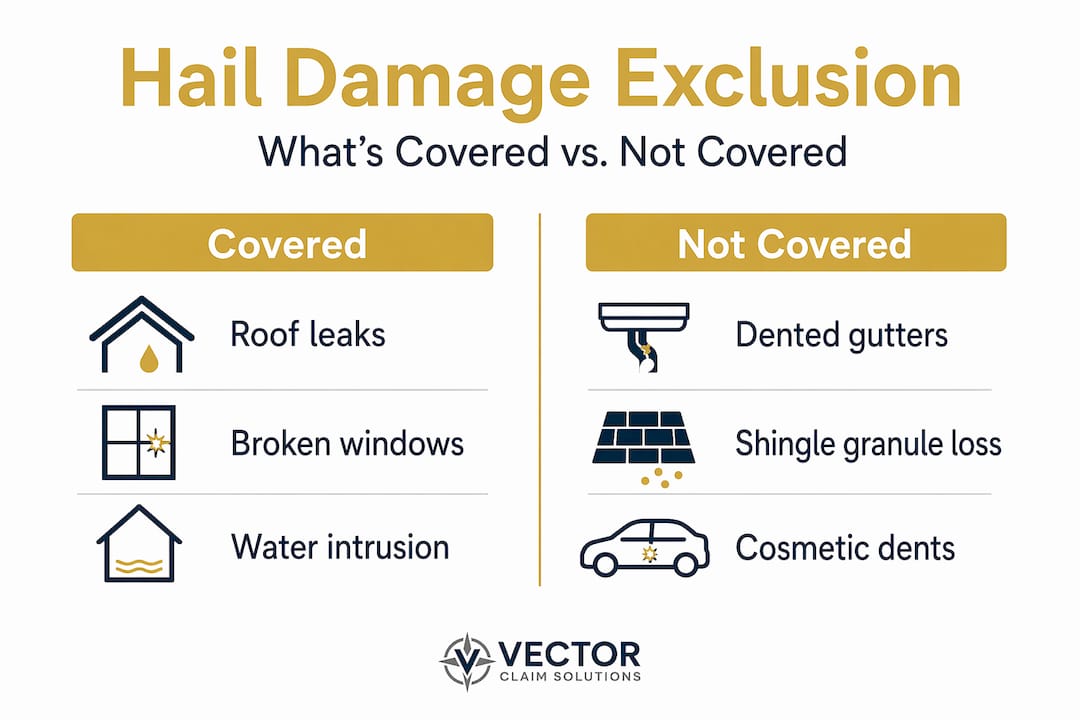
Cosmetic exclusions lead to denied claims when damage affects appearance only, even when that damage can degrade structure over time. In claims processing, cosmetic damage is generally defined as any loss that alters the look of a material without reducing its ability to perform its intended function. For a roof shingle, that means no leaks. For metal siding, that means no penetrations. Dents, dings, paint scuffing, and granule loss often fall into this category.
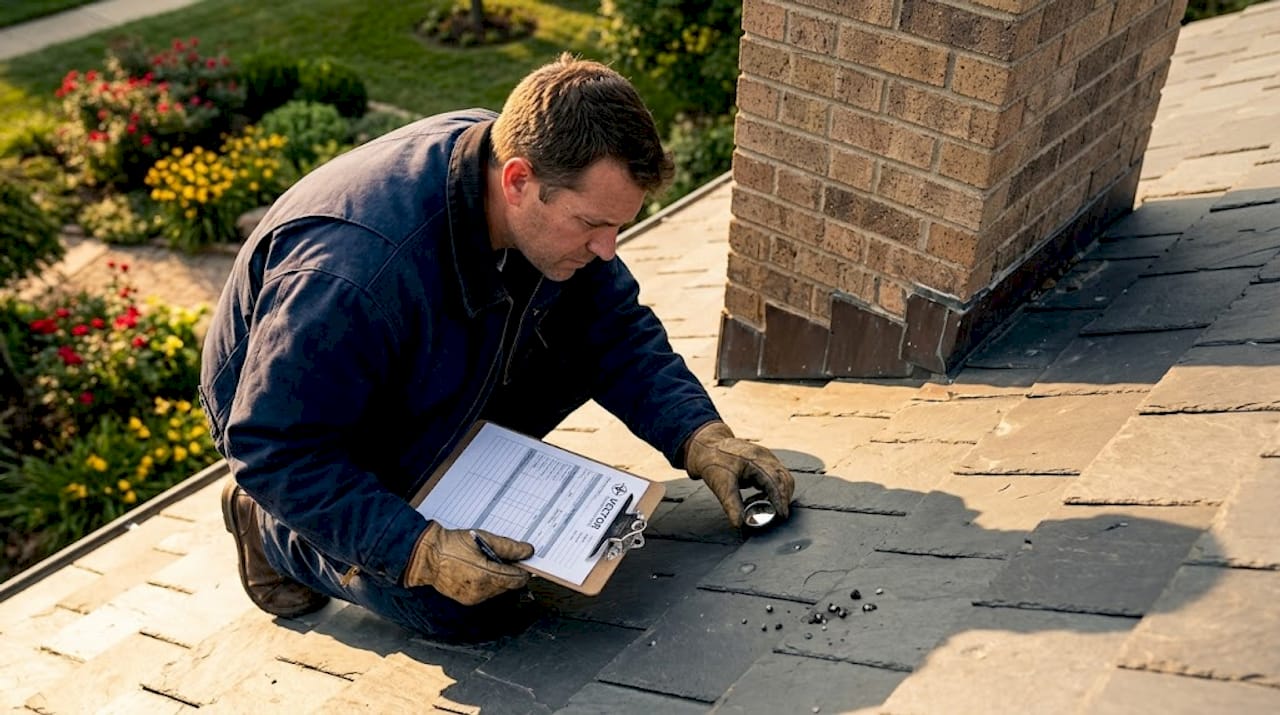
Here is where the real problem surfaces. Granule loss on asphalt shingles looks minor from the ground, but granules protect the underlying asphalt from UV degradation. Once granules are gone, the shingle ages faster and becomes brittle. A roof that appears cosmetically damaged today may develop functional leaks within two to five years. Cosmetic exclusions in your policy do not account for this trajectory. They assess the damage at the moment of the storm, not what it will become.
The table below shows common hail damage scenarios and how a cosmetic exclusion typically classifies them:
| Damage type | Cosmetic exclusion result | Long-term risk |
|---|---|---|
| Dented metal gutters (no leak) | Denied | Low to moderate |
| Granule loss on asphalt shingles | Denied | High (accelerated aging) |
| Cracked or split shingles | Covered | High (immediate leak risk) |
| Dented aluminum siding (no penetration) | Denied | Moderate |
| Broken window seals from impact | Covered | High (moisture intrusion) |
| Paint scuffing on wood trim | Denied | Low |
State regulations also vary significantly. Some states restrict insurers from applying cosmetic exclusions to roofing materials without explicit policyholder consent. Others have no such protection. If you are in Nebraska, Iowa, Colorado, Texas, or Florida, your state’s insurance commissioner website will list whether cosmetic exclusion endorsements are permitted and under what conditions.
Rising use of cosmetic exclusions means many homeowners now face denied claims unless they purchase endorsements that remove these limitations. This endorsement is sometimes called a “cosmetic damage buy-back” rider. It typically costs more in annual premium, but it restores coverage for the surface-level damage that hail most commonly causes.
Pro Tip: Ask your insurance agent directly whether your policy includes a cosmetic damage exclusion. Get the answer in writing. If it does, ask what it costs to remove it through an endorsement before the storm season begins.
Key policy elements affecting hail coverage
Understanding how your policy values damage and structures your deductible determines the real-world cost of a hail claim. These details matter as much as whether the damage is covered at all.
Deductible structures
Percentage-based wind/hail deductibles are calculated from your dwelling coverage limit, not a flat dollar amount. On a home insured for $350,000 with a 2% wind/hail deductible, your out-of-pocket cost before any claim payment begins is $7,000. Many homeowners discover this number only after filing. Your standard deductible, often $1,000 or $2,500, does not apply to wind and hail losses when a separate deductible is listed in your policy.
Replacement cost value vs. actual cash value
Claim payouts vary based on whether your policy uses replacement cost value (RCV) or actual cash value (ACV). RCV pays what it costs to replace the damaged material with a new equivalent. ACV deducts depreciation based on the material’s age and condition. On a 15-year-old roof, ACV could reduce your payout by 50% or more compared to RCV. This difference compounds when you are also dealing with an exclusion that limits which damage qualifies in the first place.
Claim processing timelines
Standard hail claims typically process in two to four weeks. After a major storm event, that window extends to four to eight weeks, and supplemental claims for missed or undervalued damage add another two to three weeks on top of that. Knowing this timeline helps you plan repairs and manage contractor relationships without assuming a check is coming faster than it will.
Key variables that affect your settlement amount include:
- Whether your policy uses RCV or ACV valuation
- The size and type of your wind/hail deductible
- Whether a cosmetic exclusion is attached to your policy
- The scope and documentation quality of your initial inspection
- Whether supplements are filed for items missed in the original estimate
Pro Tip: Review your policy’s declarations page each spring before storm season starts. Insurers block coverage changes once a storm watch or warning is issued, so adjustments must happen in advance.
Steps to take when your policy includes a hail exclusion
Discovering an exclusion in your policy after a storm is stressful. But there are specific actions you can take to protect your position and give your claim the best chance of success.
-
Read your policy declarations page carefully. Look for endorsements, riders, and exclusions listed by name. Note whether your deductible is a flat amount or a percentage of dwelling coverage. If the language is unclear, call your agent and ask for a written explanation.
-
Hire a qualified inspector before filing. A professional roof inspection creates a detailed written record of damage type, location, and severity. This documentation separates cosmetic damage from functional damage clearly, which matters when your insurer’s adjuster disputes the scope. Use a hail damage inspection checklist to make sure nothing is missed.
-
Document everything with photos and dates. Take time-stamped photos of every affected surface immediately after a storm. If you have pre-storm photos showing the prior condition of your roof or siding, preserve those as well. Well-documented claims have measurably better outcomes even when exclusions are present.
-
Explore endorsements for future protection. If your policy includes a cosmetic exclusion, contact your insurer to ask about removing it through a buy-back endorsement. Understand the premium difference and weigh it against your property’s exposure to hail risk based on your location.
-
Consider bringing in a public adjuster. When a claim is denied or undervalued because of an exclusion, a licensed public adjuster reviews the policy language, the inspection findings, and the insurer’s estimate to identify where the denial may be incorrect or where covered damage was missed. This is particularly valuable when hail damage worsens over time and the original estimate did not account for secondary effects.
Pro Tip: Never sign a release or accept a final payment until you are confident the full scope of covered damage has been addressed. Supplemental claims are your right, and signing a release may waive them.
Common misconceptions about hail damage coverage
Several persistent misunderstandings lead homeowners and property managers to make costly mistakes after a storm. Being aware of them puts you in a much stronger position.
- “All hail damage is covered.” This is not guaranteed. Coverage depends on the specific language in your policy, including any exclusions or endorsements attached to it.
- “My deductible is just $1,500.” That flat deductible may not apply to hail. Separate wind/hail deductibles can be several thousand dollars more when calculated as a percentage of dwelling coverage.
- “Cosmetic damage isn’t worth claiming.” Even denied cosmetic damage should be documented now. The same surface may develop functional damage within a few years, and your original records will matter when you file again.
- “Minor damage can wait.” Granule loss and small dents allow moisture into materials faster than most homeowners expect. Delayed repairs often convert a manageable cosmetic issue into a much more expensive structural repair.
- “Coverage is automatic after a storm.” Coverage is not automatic. Policyholders must actively file, document, and follow up on claims. Waiting passively often results in missed deadlines and reduced settlements.
My perspective on hail damage exclusion policies
I’ve reviewed hundreds of hail damage claims across Nebraska, Iowa, Colorado, Texas, and Florida, and the same situation appears repeatedly. A homeowner files a claim after a legitimate storm, the adjuster arrives, and the estimate comes back far lower than the actual repair cost. Half the time, a cosmetic exclusion or a percentage-based deductible is the reason. The other half is a scope that simply missed damage because the inspection was incomplete.
What I’ve learned is that the policy itself is the starting point, not the adjuster’s estimate. I’ve seen cosmetic exclusion denials overturned when documentation showed that granule loss had already progressed to cracking and UV degradation on the same inspection date. The exclusion applied to cosmetic damage, and the damage documented was functional. That distinction matters enormously in negotiation.
Annual policy reviews are not optional if you live in a hail-prone state. I’ve worked with property managers who discovered their cosmetic exclusion the morning after a storm. At that point, the insurer has already locked in a binding restriction. There is nothing you can do to change your coverage retroactively. What you can do is build the strongest documentation case possible and push back on any scope that undervalues the covered portion.
The honest truth is that insurers are not required to explain your exclusions to you at renewal. That responsibility falls to you. Understanding your policy language before a storm is the single most impactful thing you can do to protect your claim outcome.
— Vector
How Vectorclaimsolutions can support your hail claim
When your policy includes an exclusion or your claim comes back undervalued, having an experienced public adjuster review the situation can change the outcome significantly.

At Vectorclaimsolutions, we work exclusively on behalf of policyholders, not insurers. We review your policy language, inspect the actual damage at a construction level, and challenge estimates that miss covered losses or misapply exclusion clauses. Whether you are dealing with a cosmetic exclusion dispute, an unexpectedly high wind/hail deductible, or a denial that does not feel right, we can give you a clear second opinion. Start with our storm damage claim checklist to see where your claim stands, or explore our storm damage claim services to understand how we handle complex hail losses from start to finish.
FAQ
What does a hail damage exclusion policy mean?
A hail damage exclusion policy is a homeowners insurance contract that limits or removes coverage for losses caused by hail, either entirely or for damage deemed cosmetic. It means not all hail damage automatically qualifies for a payout.
What is a cosmetic damage exclusion in hail insurance?
A cosmetic damage exclusion denies coverage for hail damage that affects only appearance, such as dents or granule loss, without causing leaks or structural failure. These exclusions are often added in exchange for lower premiums.
How do wind and hail deductibles differ from standard deductibles?
Wind and hail deductibles are frequently calculated as a percentage of your dwelling coverage limit, not a flat dollar amount. On a $350,000 home with a 2% deductible, you owe $7,000 before your insurer pays anything.
Can I remove a hail damage exclusion from my policy?
In many cases, yes. You can ask your insurer about a cosmetic damage buy-back endorsement that restores coverage for surface-level hail damage, though it typically increases your annual premium.
When should I consider a public adjuster for a hail claim?
You should consider a public adjuster when your claim is denied due to an exclusion, when the settlement amount does not cover the full repair cost, or when you believe the insurer’s inspection missed significant covered damage.