

Filing a property insurance claim after storm damage, flooding, or a major loss is rarely as simple as making a phone call and waiting for a check. Most homeowners and commercial property owners encounter the stages of a property insurance claim for the first time under stress, and that’s exactly when confusion becomes costly. The formal process is called the property insurance claim cycle, and it follows a structured sequence that your insurer understands far better than most policyholders. Knowing each stage before you reach it gives you real leverage. It helps you meet deadlines, document damage correctly, and avoid leaving recoverable money behind.
Table of Contents
- Key Takeaways
- 1. The stages of a property insurance claim at a glance
- 2. Stage one: Claim initiation and reporting the loss
- 3. Stage two: Investigation and adjuster inspection
- 4. Stage three: Settlement, payment offers, and Proof of Loss
- 5. Stage four: Large-loss commercial property claims
- 6. Residential vs. commercial claims: a side-by-side comparison
- 7. Final tips for maximizing your claim outcome
- What I’ve learned from watching policyholders navigate the claim process
- How Vectorclaimsolutions can support your claim from start to finish
- FAQ
Key Takeaways
| Point | Details |
|---|---|
| Three core stages exist | Every property claim moves through intake, investigation, and settlement in that order. |
| Documentation drives outcomes | The more organized your records at each stage, the stronger your position during settlement. |
| Deadlines are non-negotiable | Missing Proof of Loss or repair documentation windows can reduce or void your recovery. |
| Commercial claims run longer | Large-loss commercial claims routinely take 12 to 24 months and require specialized expert involvement. |
| Recoverable depreciation isn’t automatic | You must actively request held depreciation funds after completing repairs with proper documentation. |
1. The stages of a property insurance claim at a glance
The property insurance claim process follows what experienced adjusters call a “Three Wave” paperwork and activity timeline. The first wave covers intake on days one through three. The second wave covers investigation between days seven and fourteen. The third wave covers settlement documents and payment starting around day thirty. Each wave has its own documents, decisions, and deadlines. Treating them as one continuous blur is one of the most common and expensive mistakes policyholders make.
2. Stage one: Claim initiation and reporting the loss
Your first obligation after discovering property damage is to notify your insurer promptly. Most policies use the phrase “prompt notice,” which typically means within 24 to 72 hours of discovery, though exact language varies by policy. Delay can give a carrier grounds to reduce or deny the claim.
When you call to report the loss, have the following ready:
- Your policy number and the insured property address
- Date and time the damage occurred or was discovered
- A brief description of what happened and what is visibly damaged
- Contact information for anyone who witnessed the event
After your report, the insurer assigns a claim number and sends an acknowledgment letter. You should also receive a Privacy Notice and sometimes a Property Loss Notice within the first few days. Insurance claim timelines show these intake documents typically arrive in the first one to three days. Write down the name of every person you speak with, the date, and a summary of what was discussed. That record will matter later if a dispute arises.
Pro Tip: Take date-stamped photos or video of the damage before any cleanup or emergency repairs begin. Your carrier expects you to prevent further damage, but your documentation of the original condition is equally important.
3. Stage two: Investigation and adjuster inspection
Once your claim is open, the carrier assigns a field adjuster to inspect the damage. This is one of the most consequential stages in the entire process. The adjuster’s inspection produces the initial estimate that often becomes the baseline for your entire settlement.
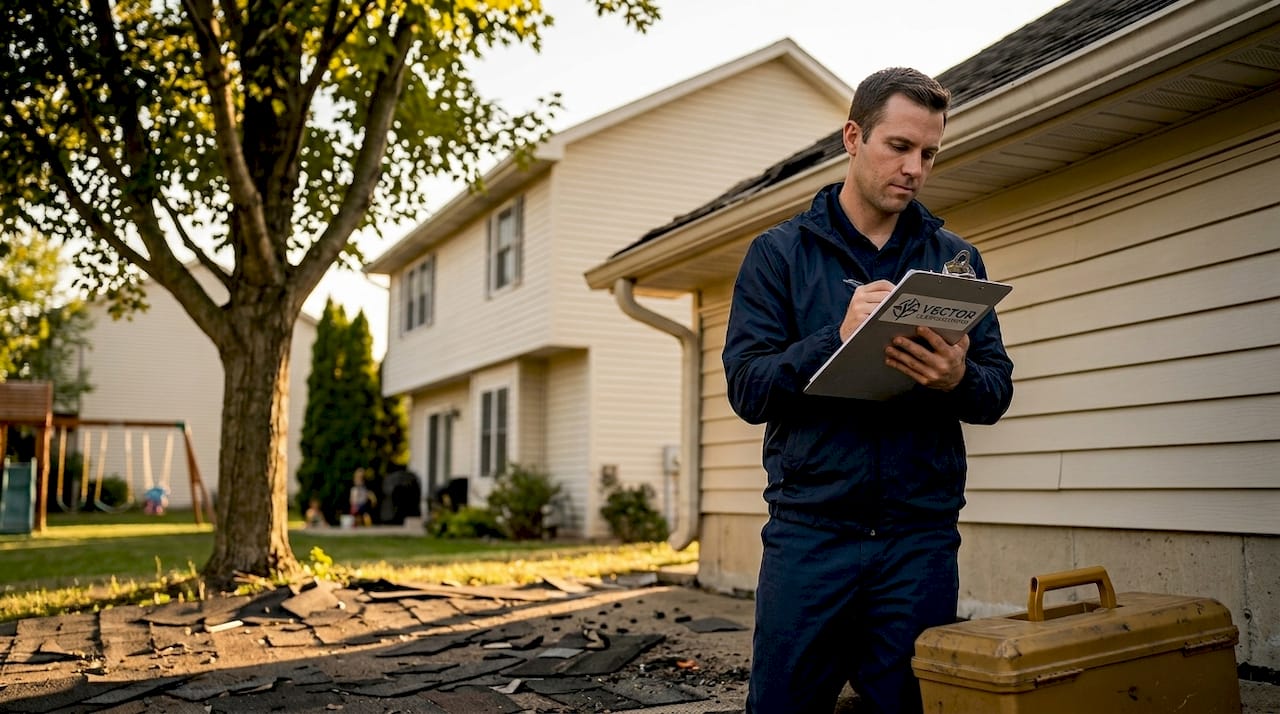
Be present during the inspection. Walk the adjuster through every area of damage you have identified, including damage that is not immediately obvious. Roofing, siding, gutters, mechanical systems, and structural components often have damage that only becomes clear on close examination. If you have already obtained contractor bids, bring them. Compare them carefully against the adjuster’s estimate, because discrepancies are common.
Under Florida insurance law, insurers must acknowledge a claim within seven to fourteen days and issue a decision or payment within sixty days. In Texas, prompt payment rules require acknowledgment within fifteen days, a coverage decision within fifteen business days after receiving all requested information, and payment within five business days after acceptance. These legal deadlines exist in your favor. If your carrier misses them, there may be penalty interest or other remedies available.
You may also receive a Reservation of Rights letter during this stage. This document means the insurer is continuing its investigation while reserving the right to deny coverage. It does not mean your claim is denied, but it warrants careful attention. Consider getting a second review of the inspection findings if the initial estimate seems low.
Pro Tip: Hire your own licensed contractor to inspect the damage independently before or immediately after the adjuster’s visit. Having a second estimate in hand gives you objective data to challenge underestimates.
4. Stage three: Settlement, payment offers, and Proof of Loss
The settlement stage is where the claim resolution happens, and it is also where policyholders most often leave money on the table. Once the insurer issues a payment offer, you will typically receive two distinct amounts if you carry a replacement cost value policy.
- Actual Cash Value (ACV) payment: This is the initial check, calculated as the estimated replacement cost minus depreciation for age and condition.
- Recoverable depreciation: This is the withheld portion, released only after you complete repairs and submit proof of completion.
Most policyholders do not realize that recoverable depreciation is not paid automatically. You must request it with documentation after repairs are finished. Missing this step means leaving real money behind.
You will also be asked to submit a Sworn Proof of Loss. This is a formal document that states the details of your loss, the amount you are claiming, and the circumstances of the damage. Proof of Loss deadlines typically fall between sixty and ninety days after the loss, and this deadline is treated as a condition precedent to final settlement. If you need more time, request an extension in writing before the deadline expires.
Before signing any release of claims form, read it carefully. Some releases are full and final, meaning you cannot return for additional payment even if hidden damage surfaces later.
| Document | Who provides it | Deadline |
|---|---|---|
| Sworn Proof of Loss | Policyholder | 60-90 days post-loss |
| Recoverable Depreciation Request | Policyholder | After repair completion |
| Release of Claims Form | Insurer | At settlement |
| Supplement Estimate | Policyholder or contractor | As discovered |
When hidden or additional damage surfaces after the initial estimate, you can file a supplement. Well-documented supplements that include revised estimates, photographs, and detailed explanations are frequently approved. Keep every receipt, photo, and contractor communication you generate throughout repairs.
Pro Tip: Never sign a full release of claims before your contractor has completed their final walk-through and confirmed that all damage identified in the claim has been addressed. Signing early can forfeit your right to supplements.
5. Stage four: Large-loss commercial property claims
Commercial property claims over a certain threshold, often defined by the carrier as losses exceeding $500,000 or involving complex coverage questions, are handled very differently from routine residential or small commercial claims. Large-loss claims routinely span twelve to twenty-four months and involve multiple expert tracks running simultaneously.
The insurer will typically assign a specialized large-loss unit rather than a general field adjuster. You can expect involvement from:
- Forensic engineers to assess structural and cause-of-loss issues
- Forensic accountants to evaluate business interruption losses
- Coverage counsel to interpret complex policy language
- Specialized estimators using construction-level pricing databases
Policy provisions like coinsurance clauses, code upgrade requirements, ordinance or law coverage, and business interruption calculations add layers that require careful documentation and often legal review. An examination under oath (EUO) is common, where the insurer formally questions key personnel about the loss.
The first 72 hours after a large commercial loss set the tone for everything that follows. Preserve evidence, restrict access, document every area with video, and retain experienced legal and public adjusting support before the insurer’s team arrives.
For business owners in Nebraska, Iowa, Colorado, Texas, and Florida, specialized commercial claim documentation from the outset is not optional. The complexity of these claims means that early, organized evidence preservation directly affects the final settlement figure.
6. Residential vs. commercial claims: a side-by-side comparison
Understanding how the claim experience differs between property types helps you set realistic expectations and prepare appropriately.
| Factor | Residential claims | Commercial property claims |
|---|---|---|
| Typical timeline | 30 to 90 days | 3 to 24 months |
| Adjuster type | General field adjuster | Specialized large-loss unit |
| Key documents | Proof of Loss, ACV check, depreciation holdback | EUO, forensic reports, BI calculations |
| Business interruption | Not applicable | Often a major claim component |
| Complexity drivers | Age of home, policy type, damage scope | Coinsurance, code upgrades, multiple coverages |
| When to escalate | Missed damages, low estimate, denial | Immediately, from day one of a major loss |
For homeowners, the residential claim process typically centers on accurate damage documentation and meeting Proof of Loss deadlines. Commercial owners face a broader set of coverage questions from the start.
Pro Tip: For any claim, residential or commercial, keep a dedicated claim folder, physical or digital, that contains every document, photo, correspondence, and payment record in chronological order. This single habit resolves more disputes than any other practice.
7. Final tips for maximizing your claim outcome
The property damage claim process rewards policyholders who stay organized and proactive. These practical steps apply across all claim types:
- Document everything from day one. Date-stamped photos, contractor estimates, and written records of every phone call are your primary tools.
- Know your deadlines. Proof of Loss windows and recoverable depreciation requests both have time limits. Calendar them immediately.
- Request supplements promptly. If additional damage surfaces after the initial estimate, document it thoroughly and file a supplement with supporting evidence.
- Review every estimate carefully. Compare the insurer’s scope of work against your contractor’s assessment. Line-item discrepancies are common and negotiable.
- Ask about how insurers calculate payments. Understanding depreciation methodology, actual cash value, and replacement cost calculations helps you identify underpayments.
- Get a second opinion on any estimate that seems low. A public adjuster or licensed contractor can identify missed scope that an insurer’s adjuster may have overlooked.
The storm damage claim checklist from Vectorclaimsolutions is a practical starting point for staying organized throughout each stage. Knowing the claim settlement stages in advance removes the guesswork and helps you respond confidently at every turn.
Pro Tip: If you receive a low initial settlement offer, do not accept it as final. Most carriers expect negotiation, and a well-documented counter with contractor support is a completely standard part of the process.
What I’ve learned from watching policyholders navigate the claim process
I’ve worked with hundreds of homeowners and commercial property owners at every stage of the insurance claim cycle, and one pattern stands out more than any other. Most people underestimate how much the process demands of them personally.
The assumption is that the insurance company handles it. The reality is that the burden of proof sits squarely with the policyholder. You have to document the damage, meet the deadlines, request the recoverable depreciation, and push back on estimates that don’t reflect actual repair costs.
What surprises me most is how many policyholders leave recoverable depreciation funds uncollected simply because they didn’t know to ask. That’s not a small oversight. On a $150,000 claim, held depreciation can represent $20,000 to $40,000 in real recovery. You earned that coverage. You paid for it.
For commercial property owners, the gap between what’s offered and what’s owed is often even wider. Large-loss claims involve coverage provisions most business owners have never read, and insurers are staffed with specialists who have interpreted those provisions thousands of times. That asymmetry is real, and ignoring it costs businesses enormously.
My honest take: the single most protective thing you can do at any stage is treat your claim like a professional project. Track every document, meet every deadline, and don’t hesitate to bring in expert support when the numbers don’t add up.
— Vector
How Vectorclaimsolutions can support your claim from start to finish
If you’re dealing with property damage and wondering whether your settlement offer reflects what your policy actually covers, you’re asking exactly the right question.
Vectorclaimsolutions is a policyholder-first public adjusting firm with deep experience in residential and commercial property claims across Nebraska, Iowa, Colorado, Texas, and Florida. We specialize in claims that are underpaid, improperly scoped, or denied. Our team handles documentation, construction-level damage analysis, and structured carrier negotiation on your behalf. Whether you’re at the intake stage or pushing back on a final settlement, a claim review by our team costs you nothing upfront. You don’t have to navigate this alone.
FAQ
What are the main stages of a property insurance claim?
The main stages are claim initiation (reporting the loss and initial documentation), investigation (adjuster inspection and damage evaluation), and settlement (payment offers, Proof of Loss submission, and final resolution). Most residential claims move through all three stages within thirty to ninety days.
How long does a property insurance claim take?
Routine residential claims typically resolve within thirty to ninety days, while large-loss commercial claims can take twelve to twenty-four months depending on complexity, expert involvement, and policy coverage disputes.
What is recoverable depreciation and how do I get it?
Recoverable depreciation is the portion of your settlement withheld until repairs are completed. You must actively request this payment with proof of completed repairs after the work is done. It is not released automatically.
When do I need to submit a Proof of Loss?
Most policies require a Sworn Proof of Loss within sixty to ninety days of the loss date. This document is a condition of final settlement, and missing the deadline can delay or reduce your recovery. Request a written extension if you need more time.
Do I need a public adjuster for my property claim?
You are not required to hire one, but a public adjuster can be particularly valuable when estimates seem low, damage has been missed, or you are dealing with a complex commercial loss. They work on your behalf and are paid from the settlement recovery rather than out of pocket upfront.