

When property damage strikes, most homeowners and commercial property owners assume their insurance carrier will handle things fairly. The reality is more complicated. The public adjuster negotiation process exists precisely because insurance companies have their own adjusters working to protect the carrier’s interests, not yours. Without someone equally skilled on your side, you risk accepting a settlement that doesn’t fully cover your repairs. This guide walks you through exactly how that negotiation process works, what strategies matter most, and what you can do right now to improve your outcome.
Table of Contents
- Key takeaways
- Understanding the public adjuster negotiation process
- Strategies that overcome insurer resistance
- How to prepare before negotiations begin
- Recognizing a fair settlement versus an undervalued one
- My take on what actually wins negotiations
- How Vectorclaimsolutions supports your negotiation
- FAQ
Key takeaways
| Point | Details |
|---|---|
| Public adjusters represent you | A licensed public adjuster works exclusively for the policyholder, not the insurance carrier. |
| Documentation drives outcomes | Thorough damage documentation and repair estimates directly determine how much you recover. |
| Negotiations follow clear stages | From policy review to supplement claims, each phase of negotiation builds on the last. |
| Preparation accelerates settlement | Organizing your records and understanding your deadlines prevents costly delays. |
| Appraisal is a real option | When negotiations stall, appraisal clauses offer an enforceable path to resolution without litigation. |
Understanding the public adjuster negotiation process
The public adjuster negotiation process is not a single conversation. It is a structured sequence of steps that starts before anyone picks up the phone with an insurer and ends only when you have a settlement that actually covers your loss. Here is how that sequence typically unfolds.
1. Retention and contract execution. A licensed public adjuster represents the policyholder exclusively, preparing and negotiating the claim on your behalf. Before any negotiation begins, you sign a contract that defines the scope of services and the fee structure. Public adjuster fees typically range from 5% to 20% of the settlement, depending on state regulations and claim complexity. Understanding this upfront prevents surprises later.
2. Policy review. Your adjuster reads your entire policy, not just the declarations page. They identify applicable coverages, sub-limits, exclusions, and any conditions you must meet to preserve your rights. This step often reveals coverage options that policyholders never knew they had, such as ordinance and law coverage or extended replacement cost provisions.
3. Damage documentation and estimate preparation. Your adjuster conducts a detailed inspection of the property and builds a repair scope using industry-standard estimation software like Xactimate. This creates an itemized, defensible estimate that mirrors the format insurers use internally, making it harder to dismiss. Photos, measurements, material specifications, and contractor input all feed into this package.
4. Claim package submission and direct negotiation. The completed claim package goes to the insurance carrier with a formal demand. From this point, your public adjuster handles all direct communication with the insurer’s representative. They push back on low estimates, challenge scope omissions, and connect specific policy language to documented damage facts to counter resistance.
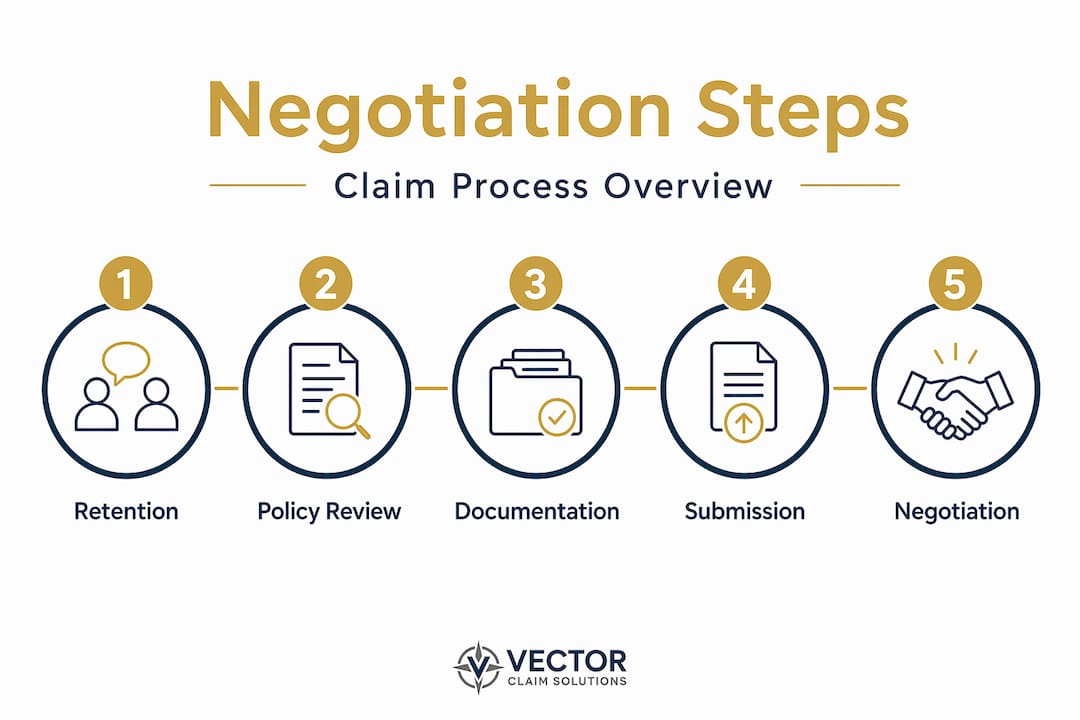
5. Supplement claims. Damage sometimes surfaces after the initial estimate is submitted. A supplement claim formally adds those newly discovered items to the negotiation. Supplement claims can meaningfully increase settlements when additional damages surface after initial agreements, so your adjuster monitors the scope throughout the repair process.
6. Deadline and communication management. Every policy contains deadlines, including proof of loss submission windows, appraisal request periods, and suit limitations. Your adjuster tracks these dates and responds to the carrier within required timeframes so you never forfeit a right through inaction.
Pro Tip: Ask your public adjuster for a written communication log at each stage. A documented record of every exchange with the insurer becomes critical evidence if the claim escalates.
Strategies that overcome insurer resistance
Understanding public insurance adjuster strategies means recognizing what adjusters are actually up against. Insurers are not always acting in bad faith, but they do use practices that slow or reduce payouts. Knowing these tactics makes the negotiation clearer for you as a property owner.
- Generic denial and delay letters. Insurance companies often use automated denial correspondence to delay claim payments. These letters are broad and difficult to counter without a policy-specific, fact-specific response. Skilled public adjusters write replies that tie exact policy language to documented damage, turning a form letter into an actionable dispute.
- Scope minimization. Carrier adjusters sometimes scope repairs to the cheapest standard rather than the correct one. Your public adjuster counters this by providing detailed line-item estimates with local material costs and contractor-verified quantities.
- Depreciation disputes. Actual cash value versus replacement cost value is a common flashpoint. Adjusters know how to document the condition and age of materials accurately so that depreciation calculations reflect reality rather than a formula that favors the insurer.
- Leveraging the appraisal clause. When negotiations over the amount of loss reach an impasse, most policies include an appraisal clause. The Texas Supreme Court reaffirmed in 2026 that appraisal can be compelled without regard to overlapping coverage disputes. This provision offers an efficient resolution path that avoids expensive litigation and applies across many states, not just Texas.
- Knowing the limits of the role. Public adjusters focus on claim preparation and negotiation, not legal advice or coverage litigation. When a claim crosses into bad faith or requires a coverage determination by a court, an attorney becomes necessary. A trustworthy public adjuster will tell you this directly.
Pro Tip: If you are dealing with insurer delay tactics, document every date a letter or email was sent or received. Patterns of unreasonable delay can support a bad faith claim if legal escalation becomes necessary.
How to prepare before negotiations begin
The quality of your preparation directly affects how fast and how well your claim resolves. Property owners who proactively document damages and coordinate with public adjusters consistently achieve higher settlements. Here is what you should have ready before the adjuster submits your claim package.
- Gather your full insurance policy, any endorsements, and all prior claim correspondence in one place.
- Collect your own photos and videos of the damage, ideally with date stamps and wide shots that show context as well as close-ups.
- Request written estimates from at least one licensed contractor so your adjuster has a real-world repair cost reference.
- Know your proof of loss deadline. Missing this date can severely limit your options.
- Understand what your adjuster’s fee covers and what happens if you receive a supplemental payment later.
The table below outlines what realistic negotiation timelines look like and what factors affect them.
| Claim type | Typical timeline | Key variable |
|---|---|---|
| Residential storm damage | 30 to 90 days | Carrier responsiveness and scope complexity |
| Commercial large loss | 60 to 180 days | Business interruption documentation and scope size |
| Supplement after initial settlement | 14 to 45 days | Speed of new damage discovery and documentation |
| Appraisal process | 30 to 60 days after demand | Availability of agreed umpire |
Setting realistic expectations matters. A well-documented claim moves faster than a poorly organized one, but no claim resolves overnight. Your job is to stay organized and responsive so you do not create delays on your side of the process.
Recognizing a fair settlement versus an undervalued one
Public adjusters help policyholders avoid insurer undervaluation by reviewing offers, identifying shortfalls, and negotiating fair payments. Once a settlement offer arrives, here is how to evaluate it.

A well-negotiated claim settlement accounts for every damaged system, including roofing, siding, interior finishes, mechanical systems affected by water intrusion, and any code upgrade requirements triggered by the repair. If you received a single-page summary with round numbers, that is a warning sign. A thorough settlement comes with a line-item scope that you can compare against contractor bids.
Watch for these red flags in a settlement offer. A number that barely covers your deductible, a scope that mentions only part of the affected area, or a high depreciation holdback with no clear path to recover it once repairs are complete. All three are common patterns in underpaid claims.
When new damage surfaces during repairs, such as hidden moisture damage behind walls, you have the right to file a supplement. Supplement claims build on initial agreements and can substantially increase your final recovery when handled properly. Your public adjuster should be monitoring this throughout the repair process, not just during the initial negotiation phase.
If negotiations stall entirely, the appraisal process described earlier gives you a structured way to resolve amount-of-loss disagreements. The enforcement of appraisal provisions enables efficient resolution while avoiding costly litigation. This option is worth understanding before you need it, not after.
My take on what actually wins negotiations
I have reviewed enough claims to know that the single biggest driver of a successful outcome is not confidence or persistence. It is organized, specific documentation tied directly to policy language.
When a carrier pushes back on a claim, a generic rebuttal rarely moves the needle. What works is a response that references the exact policy section, cites the actual damage scope, and explains why the repair method is required under current building codes. Manual synthesis of policy clauses with documented damage facts is the skill that turns stalled negotiations into successful settlements. That is not something automated software handles well on either side of the table.
I have also seen property owners hold unrealistic expectations about what a public adjuster can accomplish without their cooperation. When a client delays returning signed authorizations, withholds contractor estimates, or misses a proof of loss deadline, the adjuster’s leverage shrinks significantly. The negotiation is a team effort. Your preparation is not optional.
One more thing worth saying directly: public adjusters are powerful advocates within their legal scope, but they are not attorneys. When a claim crosses into coverage denial territory or involves allegations of bad faith, that is when you need legal counsel alongside your adjuster, not instead of one.
— Vector
How Vectorclaimsolutions supports your negotiation
When you are dealing with a disputed or underpaid claim, having the right team behind you makes a measurable difference. At Vectorclaimsolutions, we specialize in identifying what was missed, undervalued, or improperly scoped in your claim and correcting it through precise documentation, construction-level analysis, and structured negotiation with your carrier.
Whether you own a home in Nebraska or a commercial property in Texas, we build your claim package from the ground up using the same tools and terminology your insurer’s adjusters use internally. That means no guesswork and no vague estimates. If you already have a settlement offer, we can review your existing claim to determine whether it reflects the full scope of your loss. For homeowners, our residential claims support covers storm, hail, wind, and water damage across all the states we serve. Commercial property owners can explore our commercial property guidance for large-loss claims and business interruption support. The first step is understanding what you are actually owed.
FAQ
What does a public adjuster do during negotiations?
A public adjuster represents you exclusively, preparing the claim, documenting damages, and negotiating directly with the insurance carrier’s representatives to secure a fair settlement on your behalf.
How long does the public adjuster claims process take?
Timelines vary by claim type and carrier responsiveness. Residential storm claims typically resolve within 30 to 90 days, while commercial large-loss claims can take 60 to 180 days or longer when business interruption is involved.
What happens if my insurer and I can’t agree on the settlement amount?
Most policies include an appraisal clause that allows both sides to appoint independent appraisers. The appraisal provision is enforceable even during coverage disputes and often resolves amount-of-loss disagreements without going to court.
How much does a public adjuster charge?
Public adjuster fees typically range from 5% to 20% of the final settlement amount, depending on your state’s regulations and the complexity of your claim. Fee terms are outlined in the contract you sign before the adjuster begins work.
Can a public adjuster reopen a claim I already settled?
In many cases, yes. If new damage is discovered or the original settlement was incomplete, your adjuster can file a supplement to increase recovery based on the newly documented scope, provided your policy’s time limitations have not expired.