
When hail hits your property, you might assume that a storm report from the National Weather Service automatically proves your insurance claim. That assumption is one of the most common and costly mistakes homeowners make. The role of storm report in hail claims is more nuanced than a simple yes or no. Hail-related claims account for roughly 31% of total claim volume with many insurers, which means carriers scrutinize every piece of evidence. This guide breaks down exactly what storm reports prove, what they don’t, and how to use them to your advantage.
Table of Contents
- Key Takeaways
- How storm reports function in the hail claim process
- What storm reports do and don’t prove in insurance claims
- Limitations of storm reports and the need for property-specific analysis
- Best practices for using storm reports effectively
- Real scenarios: how storm reports shaped claim outcomes
- What I’ve learned about storm reports and hail claims
- How Vectorclaimsolutions helps you build a stronger hail claim
- FAQ
Key Takeaways
| Point | Details |
|---|---|
| Storm reports confirm events, not damage | A report verifies hail occurred in an area but does not prove damage at your specific property. |
| Property inspection is non-negotiable | A physical roof and exterior assessment is required to establish actual damage and causation. |
| Date alignment protects your claim | Your meteorologist, adjuster, and engineer must agree on the same date of loss to avoid denial. |
| Multiple data sources strengthen evidence | Cross-referencing radar, storm reports, and inspection findings creates a defensible claim package. |
| Early documentation is your best asset | Photographing damage and filing promptly protects your claim against timeline disputes. |
How storm reports function in the hail claim process
Storm reports are official records documenting weather events as they occur. The two most commonly referenced sources in insurance hail claims are the National Weather Service Local Storm Reports and the NOAA Storm Events Database. Both capture critical data: the size of hail measured in inches, the general location of the event, the time it occurred, and the source of the observation.
That last point matters more than most homeowners realize. Storm reports draw from multiple inputs including automated surface observation systems, trained storm spotters in the field, and emergency management agencies. Ground-truth reports from trained storm spotters complement radar data by providing real-time surface confirmation. A spotter standing in a parking lot and measuring a golf ball-sized hailstone creates a very different kind of record than a radar estimate.
Here is what a well-documented storm report typically includes:
- Date and time of the hail event
- County or general location where hail was observed
- Hail diameter in inches as observed or estimated
- Source of the report (trained spotter, law enforcement, emergency manager)
- Any associated damage notes recorded at the time
Pro Tip: When you pull a storm report, cross-check the observation location against your property address. Reports are often tied to a single observation point, which may be miles from your home.
The limitation worth understanding clearly is this: a storm report confirms a hail event in the vicinity but does not automatically prove damage at your insured property due to narrow hail swaths and variable impact. Storm reports are foundational, not conclusive.
What storm reports do and don’t prove in insurance claims
This is where most homeowners run into trouble. Understanding the evidentiary role of storm reports in insurance hail claims means understanding what they were designed to do. Storm reports were created to document meteorological events. They were not created to serve as damage assessments. That distinction has real consequences for your claim.
When you file an insurance claim, the carrier uses storm reports to verify that a hail event consistent with your reported date of loss actually occurred in your geographic area. That verification step matters enormously. Without a storm report, an insurer has grounds to question whether hail occurred at all.
Storm reports serve as meteorological context, not an opinion on claim validity. Claims require coordinated expert assessment integrating weather, engineering, and adjuster input.
Where things go wrong is when a homeowner or their contractor treats the storm report as the end of the evidence chain rather than the beginning. A report covering a five-county area cannot tell you whether hail hit the north slope of your roof. That requires a physical inspection by a qualified roofing professional.
Common pitfalls that lead to denied or disputed claims include:
- Mismatched dates: Filing a claim with a loss date that does not match any storm report record in your area
- Relying on a single data source: Using only a storm report without supporting inspection documentation
- Proximity assumption: Believing that a storm observed three miles away definitely caused damage at your address
- Premature permanent repairs: Making structural repairs before an adjuster inspects, which eliminates the ability to verify original damage
Claims are frequently denied when adjusters, engineers, and meteorologists are not aligned on the exact date of loss. Discrepancies between claim documents cause coverage challenges that are difficult to resolve after the fact.
Pro Tip: Before filing, verify the storm date on your claim matches at least one official NWS Local Storm Report or NOAA record. If there is any ambiguity about the date, engage a forensic meteorologist before submitting.
Limitations of storm reports and the need for property-specific analysis
Hail does not fall uniformly. A single storm can produce a swath of large hail just a few blocks wide while leaving neighboring streets completely unaffected. This is not an unusual edge case. It is a fundamental characteristic of how hail storms move and behave. Recognizing this reality is central to understanding the true role of storm reports in hail claims.
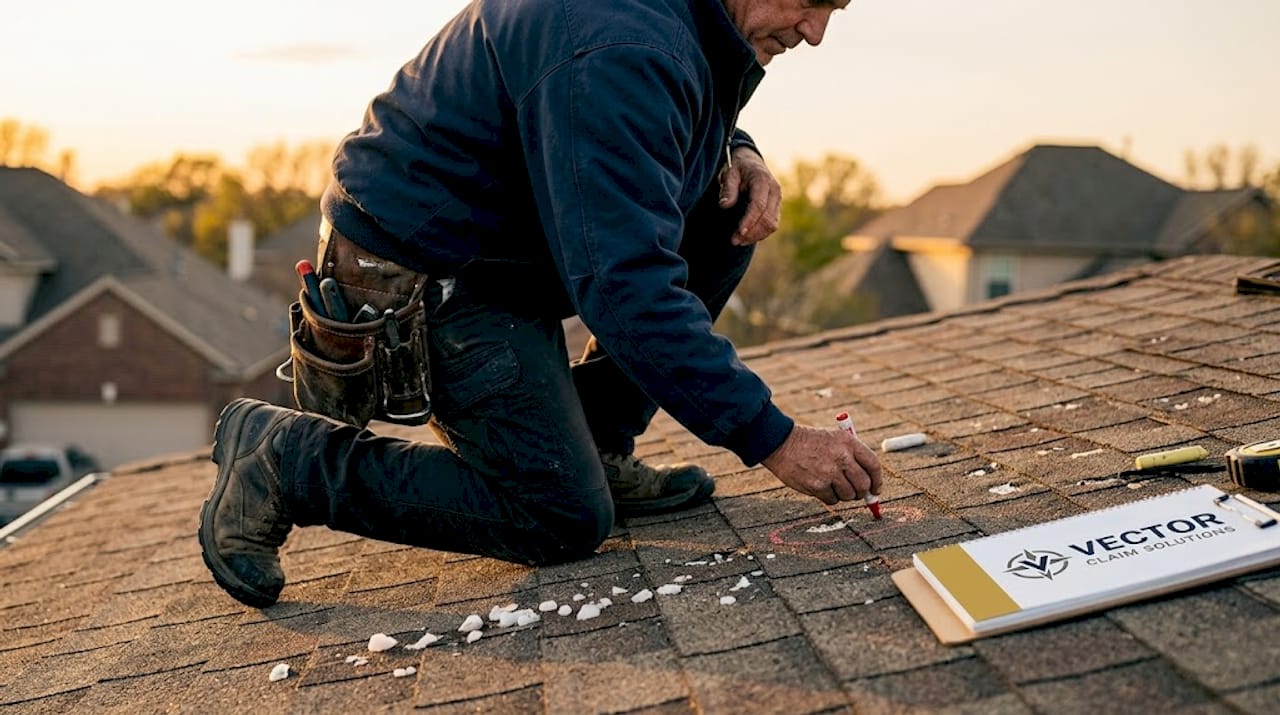
Radar data provides a broader picture of storm coverage, but even high-resolution radar has spatial limitations at the ground level. Forensic meteorology uses multiple independent weather data sources including radar scans, storm reports, and surface observations to reconstruct storm timing and hail exposure at a property-specific level. This is the standard your claim evidence should be held to.
| Evidence Type | What It Establishes | What It Cannot Establish |
|---|---|---|
| NWS Storm Report | Hail occurred in the general area on a specific date | Damage at your specific property |
| Radar Analysis | Storm track, hail size estimates, coverage area | Whether hail actually struck your roof |
| Storm Spotter Report | Ground-level hail confirmation near an observation point | Hail impact at addresses away from the spotter |
| Professional Roof Inspection | Actual physical damage present on your property | The specific storm that caused the damage |
| Aligned Expert Reports | Coordinated date of loss and causation theory | N/A when all experts agree |
Sufficient meteorological evidence is needed before initiating litigation or claim filing to establish a credible theory of loss tied to a specific storm event within the policy period. Without that foundation, even a valid claim can collapse under scrutiny.
Pro Tip: Ask your roofing contractor or public adjuster whether their inspection report documents the specific storm date as the likely cause. A report that only describes damage without tying it to a date leaves your claim exposed.
Best practices for using storm reports effectively
Knowing that storm reports are one piece of a larger puzzle, your job as a homeowner or property manager is to build the complete picture. Here is a structured approach that supports stronger claim outcomes.
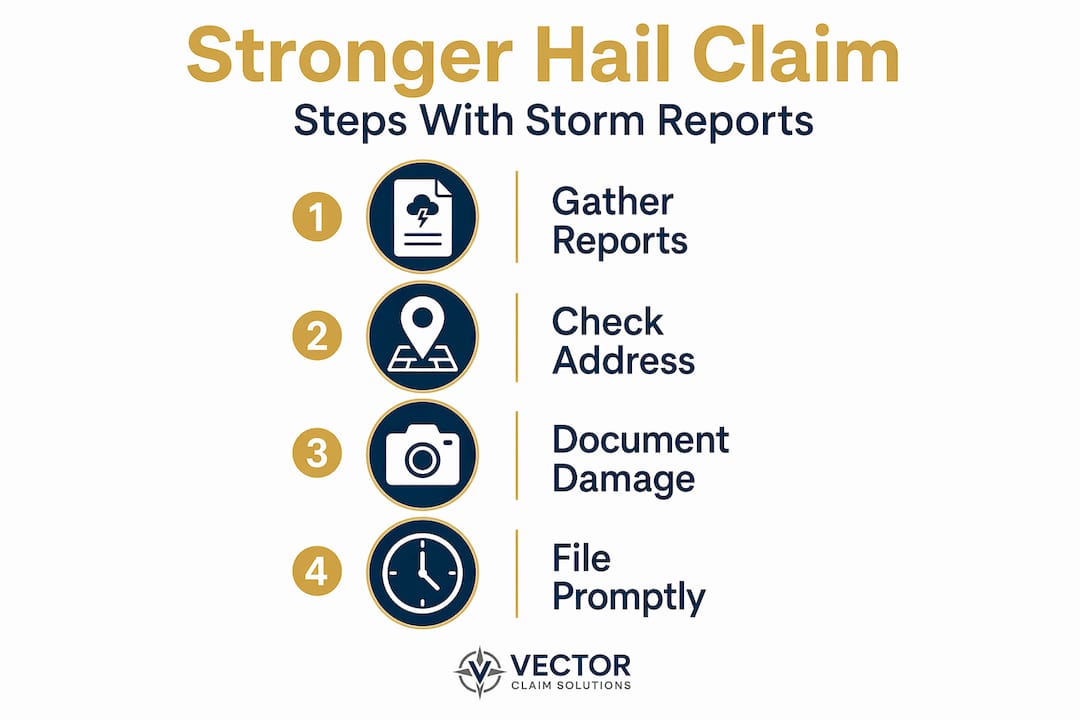
Step 1: Obtain official storm reports promptly. Access the NWS Local Storm Reports and NOAA Storm Events Database online. Search by your state, county, and the date of the suspected storm. Download and save these records.
Step 2: Document your property damage immediately. Photograph every surface that may have sustained hail impact: roofing, gutters, downspouts, window screens, AC units, and siding. Time-stamped photos taken within 24 to 48 hours of the storm are far more persuasive than photos taken weeks later. You can use this hail damage inspection checklist to make sure you cover every area.
Step 3: Cross-reference your storm report with your inspection findings. The date on your storm report and the date documented in your inspection report must match. Cross-referencing NWS storm reports with professional inspection reports creates stronger evidence tying damage to the specific hail event rather than pre-existing maintenance issues.
Step 4: File with your insurer without delay. Most insurance policies require claims to be filed within specific timeframes, commonly 6 to 24 months, but filing within 48 hours after hail damage strengthens your position considerably.
Step 5: Avoid permanent repairs before the adjuster inspects. Do not make permanent repairs before insurer inspection unless you are mitigating further loss. Premature repairs can undermine your claim if original damage cannot be verified.
Additional documentation that supports your claim:
- Written inspection report from a qualified roofing contractor
- Photos organized by date, location, and damage type
- Copies of all correspondence with your insurer
- Emergency repair receipts if temporary mitigation was necessary
- A public adjuster or forensic meteorologist report where warranted
Real scenarios: how storm reports shaped claim outcomes
Understanding theory is useful. Seeing how it plays out in real claims is more useful still.
Scenario 1: The well-supported claim. A homeowner in Nebraska reported hail damage to their roof after a May storm. They downloaded the NWS Local Storm Report showing 1.75-inch hail confirmed by a trained spotter two miles from their address. They filed within 72 hours, submitted time-stamped photos from the day of the storm, and had a roofing contractor provide an inspection report referencing the same storm date. The claim was paid without dispute.
Scenario 2: The denied claim due to date mismatch. A property manager in Colorado submitted a claim listing a loss date that did not match any official storm report in the county. A storm had occurred, but four days earlier than the date on the claim form. The insurer denied the claim citing lack of meteorological evidence for the stated date. The denial was eventually reversed after a forensic meteorologist reconstructed the correct storm timeline, but the process cost months and significant legal fees.
- Inconsistent dates between claim forms and storm records are one of the leading causes of avoidable denials
- Multiple storms in a single season create confusion when homeowners cannot identify which event caused which damage
- Policyholders who align their experts on a consistent date and cause of loss have stronger claims and avoid common pitfalls leading to denials
- Early and thorough documentation is what separates resolved claims from prolonged disputes
Scenario 3: The multi-storm confusion. A Florida homeowner experienced three significant hail events within a six-month period. Without precise meteorological analysis, their insurer argued the damage was cumulative and blamed pre-existing conditions. A forensic meteorologist’s analysis isolated the storm with the highest hail kinetic energy at the property’s specific coordinates, allowing the claim to be properly scoped and paid. This kind of storm report analysis is exactly what separates a paid claim from a denied one.
What I’ve learned about storm reports and hail claims
I’ve worked through enough hail claims to know that the storm report is where the conversation starts, not where it ends. The homeowners who struggle most are the ones who hand a carrier a NWS report and expect that to be sufficient. It never is, and it was never designed to be.
What I’ve also seen is how much a coordinated approach changes outcomes. When the adjuster, the roofing expert, and the meteorological evidence all point to the same date and the same cause, carriers have very little room to push back. That alignment is not accidental. It takes deliberate documentation from the moment the storm passes.
The uncomfortable truth is that many claims are denied not because the damage didn’t happen, but because the evidence wasn’t organized well enough to prove it. The storm data existed. The damage was real. The documentation just didn’t connect the two clearly. That is a fixable problem, and it is exactly what a skilled public adjuster is positioned to solve.
If you are staring at a denied claim or a low estimate and you know hail hit your property, do not accept that outcome without a second review. The evidence hierarchy exists to protect policyholders. You just need someone who knows how to use it correctly.
— Vector
How Vectorclaimsolutions helps you build a stronger hail claim

At Vectorclaimsolutions, we work with homeowners and property managers across Nebraska, Iowa, Colorado, Texas, and Florida who are navigating exactly these challenges. Storm report analysis is one piece of what we do. We also review your inspection findings, coordinate with meteorological experts when needed, and make sure your date of loss documentation is consistent across every claim document before it reaches your carrier.
If your claim has been denied, underpaid, or feels like it stalled without explanation, the problem is usually in the documentation. We specialize in identifying those gaps and correcting them. Start with a review of your hail damage claim or reach out to explore whether a public adjuster review makes sense for your situation.
FAQ
What does a storm report prove in a hail claim?
A storm report confirms that a hail event occurred in a general area on a specific date. It does not prove that hail struck your property or caused damage, so it must be combined with a physical inspection and aligned expert documentation.
Can my hail claim be denied even with a storm report?
Yes. Claims are frequently denied when the date of loss on the claim does not match storm report records, or when there is no property-specific inspection tying the damage to that event. A storm report alone is not sufficient proof of damage.
How do I find an official storm report for my area?
You can search the NWS Local Storm Reports and the NOAA Storm Events Database online by state, county, and date. Download and save these records as part of your claim documentation package.
Why does the date of loss matter so much in hail claims?
Adjusters, engineers, and meteorologists must all agree on the same date of loss for a claim to hold up. Discrepancies across claim documents can trigger denials or complicate litigation, even when the underlying damage is legitimate.
When should I hire a public adjuster for a hail claim?
Consider bringing in a public adjuster when your claim has been denied, your estimate seems too low, or you have experienced multiple storms and need help isolating causation. A public adjuster coordinates the evidence, negotiates with your carrier, and works on your behalf throughout the process.