
Many valid hail claims get reduced or denied not because the damage isn’t real, but because proving exactly when it happened is harder than most property owners expect. Insurers frequently argue that visible hail damage is actually the result of gradual aging, prior storms, or routine wear rather than a single covered event. If you’ve recently filed a claim and received pushback about damage “being too old,” you’re not alone, and you’re not out of options. This article breaks down the reasoning behind these disputes, what insurers actually look for, and the steps you can take to protect your claim.
Table of Contents
- Why insurance companies care about the age of hail damage
- How insurers determine and challenge hail damage age
- Common dispute scenarios and evidence insurers use
- Proactive strategies for property owners facing hail damage disputes
- Why standard advice about hail damage claims is not enough
- Connect with expert help for your hail damage claim
- Frequently asked questions
Key Takeaways
| Point | Details |
|---|---|
| Age impacts payout | Insurers use roof age to reduce claim payments or deny coverage when damage looks old. |
| Evidence is critical | Clear, event-tied photos and reports help overcome claims that damage is not recent. |
| Prompt action matters | Report and document hail damage quickly to preserve evidence insurers can’t easily dispute. |
| Expert help increases odds | Using third-party adjusters and forensic inspectors can strengthen your case in age-based disputes. |
Why insurance companies care about the age of hail damage
Now that we’ve set the stage, let’s break down exactly why insurers are so focused on the age of your hail damage and what’s at stake financially.
At the center of most hail claim disputes is a single question: is this damage the result of a covered storm event, or did it develop over time through normal use and exposure? The answer directly determines what your insurer pays, and how much. Most homeowner and commercial policies offer one of two payment methods:
- Actual Cash Value (ACV): The replacement cost of your roof minus depreciation. The older and more worn your roof appears, the lower this number gets.
- Replacement Cost Value (RCV): The full cost to replace your roof at today’s prices, with no deduction for age or condition.
How insurance payouts are calculated varies significantly depending on which method applies to your policy and how the insurer classifies the damage. This matters enormously because, as documented in ACV vs. RCV disputes, ACV payouts are reduced by depreciation tied to the assumed remaining useful life, and those inputs can change the settlement amount dramatically.
When an insurer argues that hail damage is old or pre-existing, they shift the classification toward ACV at a lower value, or deny the claim entirely by assigning the damage to a non-covered cause. A key reason this tactic works is that wear and tear exclusions give carriers a direct path to frame ambiguous damage as normal deterioration rather than a sudden, covered hail event.
“Just because your roof shows impact marks doesn’t mean your insurer will accept them as storm-specific. They have both the motive and the tools to argue otherwise.”
The financial stakes are real. On a residential claim, the difference between ACV and RCV can easily be $10,000 to $30,000. On a commercial property, that gap can exceed six figures. A hail damage claim review with a qualified professional can help you understand exactly where your settlement stands and whether you’ve been underpaid based on age assumptions.
Pro Tip: Always check your policy declarations page to confirm whether you have ACV or RCV coverage before filing a claim. This single detail shapes every negotiation that follows, including repair vs. replacement decisions you’ll need to make.
How insurers determine and challenge hail damage age
Understanding the “why” behind insurer disputes, let’s see how they decide whether your claimed damage really matches a recent storm.
When a claim comes in, the insurer doesn’t simply take your word for when the damage occurred. They run a structured review process that typically includes the following steps:
- Pull meteorological records. Carriers access weather databases, radar history, and storm reports to identify whether a qualifying hail event occurred near your property on or around the claimed date of loss.
- Commission a field inspection. An adjuster or independent inspector examines the roof for physical markers like spatter patterns, granule loss, bruising on shingles, or dents in metal components.
- Compare evidence to storm timeline. The physical findings are cross-referenced with the weather data to determine consistency. Gaps between the two create room for dispute.
- Identify competing explanations. If prior storms, foot traffic damage, or general aging can explain the observed conditions, those alternatives become the basis for a denial or reduction.
The challenge, according to forensic hail dating research, is that multiple storms may occur during a roof’s service life, making event-level attribution far more complex than a simple before-and-after comparison. You can’t always tell which storm caused which mark.
Adding to the complexity, meteorological evidence alone cannot prove roof damage, but it can support or undermine the timing of your claim. Radar data showing a hail event near your address is helpful, but it’s not a standalone win. It needs to be paired with physical evidence, inspection records, and proper documentation.
Here’s a comparison of how documentation strength affects claim outcomes:
| Evidence type | Insurer’s ability to dispute | Impact on settlement |
|---|---|---|
| Weather radar alone | High | Low to moderate |
| Photos without timestamps | High | Low |
| Time-stamped photos after storm | Moderate | Moderate |
| Qualified inspector report | Low | High |
| Inspector report plus meteorological data | Very low | Highest |
Pro Tip: Use the hail inspection checklist to prepare before your adjuster arrives. Showing up organized with pre-inspection documentation puts you in a much stronger position during claim negotiation.
Consider also reviewing the roof inspection process used by qualified roofing professionals to understand what markers they look for when dating hail impacts.
Common dispute scenarios and evidence insurers use
Now that you know the tools and tactics insurers use, let’s look at how these disputes play out and what evidence truly matters.
The most common scenarios where property owners face age-related hail disputes include:
- Older roofs in repeat-storm areas: Nebraska, Colorado, and Texas see multiple hail seasons every year. If your roof is 10 or more years old and you’ve lived through several storms, an insurer may argue that any damage visible today accumulated over many events, not just the most recent one.
- Delayed claim filing: Waiting weeks or months to file after a storm gives insurers more room to argue that you can’t confidently link the damage to a specific event. Evidence can degrade and appear less fresh after exposure and time, as noted in this hail damage glossary, making it easier for a carrier to question whether impacts are actually recent.
- Roofs with pre-existing issues: If your roof had prior repairs, documented leaks, or visible aging before the claimed storm, insurers will point to those conditions as the primary cause of damage.
- Sub-severe hail events: Hail under one inch in diameter may not cause immediately visible functional damage, but repeated exposure can accelerate aging. IBHS research on hail and roof aging confirms that repeated sub-severe hail can exacerbate natural aging, though this doesn’t automatically prove that hail caused the damage from a forensic standpoint. Insurers may use this ambiguity to their advantage.
The evidence insurers commonly rely on to challenge your claim includes historical aerial imagery, prior claim records, inspection reports noting pre-existing deterioration, and the absence of fresh hail markers like bright impact bruising or exposed substrate.
Your best counter-evidence includes time-stamped photos taken immediately after the storm, a detailed inspection report from a qualified roofing professional, storm data tied to your specific address, and statements from neighbors who experienced similar damage. If you’ve faced a denial based on age arguments, reviewing your situation through a denied claim specialist or exploring the full range of claim types covered can clarify your options.
You can also look into the roof certification process as a tool for establishing pre-storm baseline condition, which is valuable evidence if a future storm occurs.
Key stat: Hail causes billions of dollars in property damage in the U.S. each year, yet a significant portion of claims are disputed or underpaid due to documentation gaps and age-related arguments. Getting the evidence right from the start is the single most effective way to protect your payout.
Proactive strategies for property owners facing hail damage disputes
With the challenges clear, you need practical steps. Here’s what policyholders can do to proactively safeguard their claims and reduce the risk of a damaging age dispute.
- Document your roof’s condition before a storm ever hits. Annual photos of your roof, including close-ups of granule condition, flashing, and any prior repairs, create a clear baseline. If a storm occurs and you can show what existed before versus after, the “pre-existing” argument loses power.
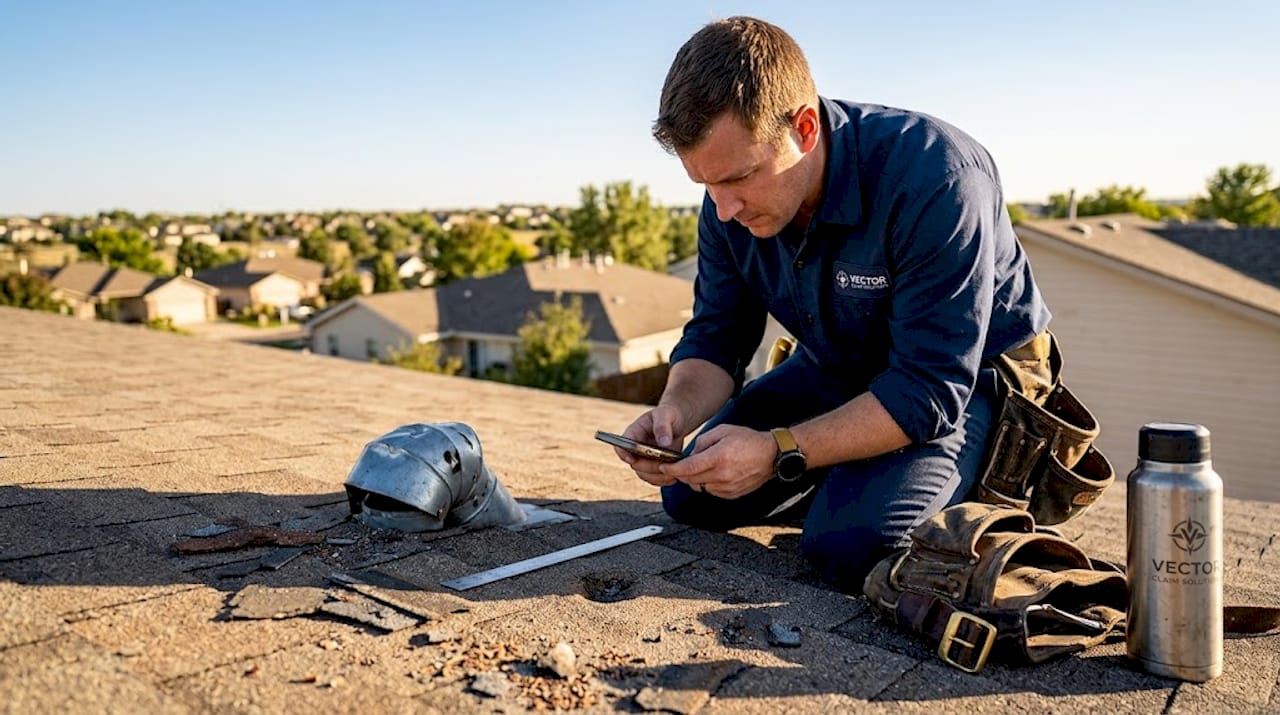
- Report and document immediately after a storm. Waiting weeks can obscure hail damage patterns and make fresh photos harder for an adjuster to dispute. Take time-stamped photos from multiple angles, including gutters, downspouts, window trim, AC units, and any soft metal surfaces that show impact clearly.
- Hire a qualified roofing inspector before the insurer’s adjuster visits. An independent inspection report gives you an expert baseline that’s harder to dismiss. Look for inspectors with documented hail experience who can note specific hail markers, size indicators, and impact patterns.
- Gather meteorological evidence specific to your address. Free tools like NOAA’s storm event database and commercial weather services can provide date-specific hail reports for your exact location. This data supports the timing of your claim and directly counters arguments that no qualifying storm occurred.
- For large or commercial claims, engage forensic experts early. Engineering inspections combined with forensic meteorology can determine the most likely storm responsible for damage at the event-date level, which is the most direct answer to an age dispute. This approach is especially valuable when multiple prior storms complicate attribution.
- Work with a public adjuster on complex or disputed claims. A public adjuster works for you, not the insurance company. They review the policy, inspect the damage independently, compile the supporting documentation, and negotiate the settlement on your behalf.
Pro Tip: Don’t overlook soft metal surfaces like gutters, vents, and HVAC equipment when documenting storm damage. These surfaces show hail impact clearly and are very difficult for insurers to argue as “wear and tear.” They provide some of the strongest time-specific evidence available. For broader storm claim support, use a structured storm documentation checklist from the start.
If you’re already in a dispute, getting a prompt and thorough roof repair assessment from a credentialed contractor can reinforce the physical evidence in your file.
Why standard advice about hail damage claims is not enough
With practical strategies in hand, let’s step back and challenge some of the most common advice on claim disputes, because the typical guidance often falls short.
Most articles on this topic tell you to take photos, file quickly, and call your insurer. That’s reasonable, but it misses the real challenge entirely. The core problem in age-related hail disputes is not documentation quantity. It’s documentation precision.
We’ve reviewed claims where policyholders submitted 200 photos within 48 hours of a storm and still faced a partial denial. Why? Because the photos showed damage without establishing that the damage was physically consistent with the specific storm event claimed. The insurer’s expert pointed to oxidation patterns and granule loss distribution that, in their assessment, suggested the shingles had been deteriorating for years. Photos alone couldn’t answer that argument.
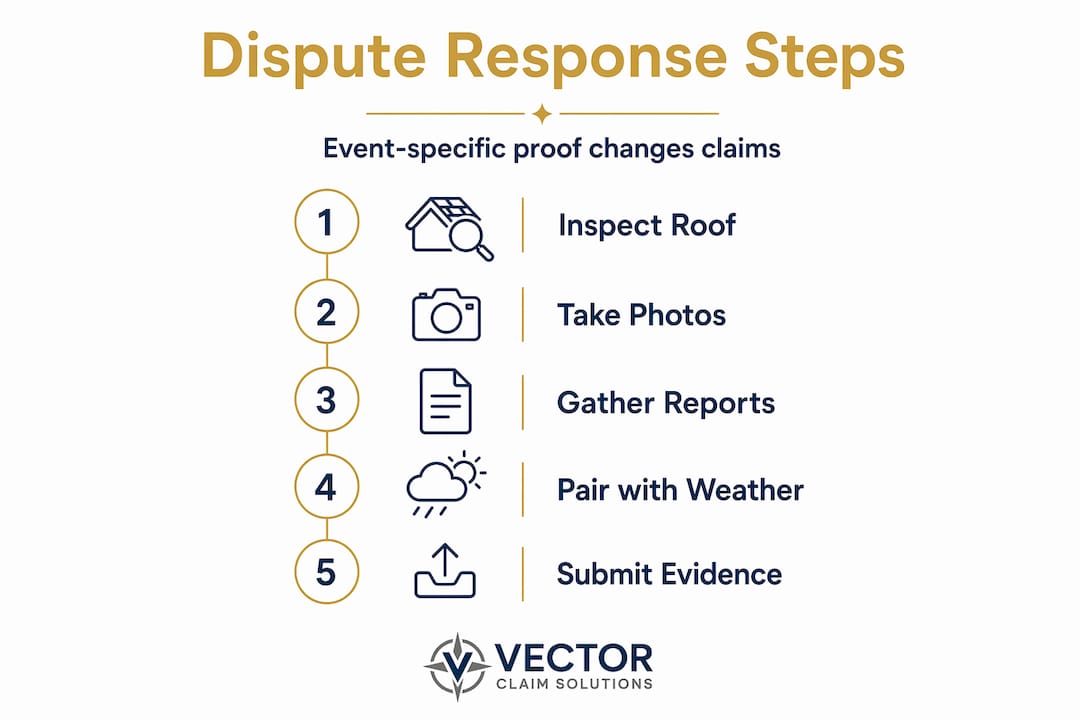
What actually changes the outcome in these disputes is event-specific attribution. That means pairing physical inspection findings with time-stamped meteorological data, and presenting both through an expert who can speak to the relationship between the storm and the observed damage pattern. This is not something most policyholders know to pursue on their own, and it’s not something a standard adjuster walkthrough will produce.
Insurers are well-practiced at using ambiguity. When two explanations are technically plausible, standard documentation favors the one that costs the carrier less. That’s why what actually works in claim disputes is a structured, expert-driven approach that removes ambiguity from the equation rather than hoping the insurer interprets photos favorably.
The other piece of advice that fails policyholders is the idea that disputing a claim is adversarial and risky. In our experience, a well-documented, professionally supported claim rarely escalates into a prolonged fight. Insurers settle when the evidence is clear and professionally presented. The fight happens when the evidence is weak or scattered, which is precisely the outcome that better preparation prevents.
Connect with expert help for your hail damage claim
If you’re pressed for time or facing a hard-nosed insurer, here’s where expert help fits in.
Navigating an age-related hail dispute is stressful, and the documentation and negotiation process can feel overwhelming, especially while managing repairs and daily life. That’s exactly where we step in.

At Vector Claim Solutions, we work directly for policyholders across Nebraska, Iowa, Colorado, Texas, and Florida. We review your claim, inspect your damage with construction-level precision, and build the kind of documentation package that stands up to insurer scrutiny. Whether you’re looking to maximize your settlement or need help understanding why your payout seems low, we can assess your situation quickly and clearly. If you’re ready to push back on an underpaid or denied hail claim, request a claim review today. Commercial property owners dealing with large-loss situations can also access our dedicated commercial claim process support for more complex scenarios.
Frequently asked questions
How do insurers calculate depreciation for hail-damaged roofs?
Depreciation is calculated per line item using the roof’s age, condition, and assumed useful life, which reduces the actual cash value (ACV) payout compared to what a full replacement cost value (RCV) settlement would provide.
What evidence can prove hail damage is from a specific storm?
Event-dated photos, a qualified roofing inspection, and meteorological records like radar or storm reports are the strongest combination for tying physical damage to a specific covered hail event.
Can multiple hailstorms over the years affect my claim?
Yes. In hail-prone regions, multiple storms over a roof’s life complicate attribution and give insurers grounds to question whether visible damage is actually from the most recent event.
Why do insurance companies say hail damage is just “wear and tear”?
Insurers use wear and tear framing to reclassify ambiguous damage as a non-covered cause, which allows them to deny or reduce claims when storm-specific physical evidence hasn’t been clearly established.