

Getting fair outcomes after a property insurance claim often stalls because carriers lowball estimates or deny coverage for damage they do not document. Most public adjusting services use generic repair templates or skip negotiation tactics that tie missed damage back to policy language, leaving owners to pay out of pocket or accept incomplete restoration. This comparison covers negotiation approach, fee structure, and damage documentation across six public adjusting firms so you can select one that aligns with your claim needs and minimizes risk of missed recovery.
Table of Contents
Vector Claim Solutions
At a Glance
They operate across Nebraska, Iowa, Colorado, Texas, and Florida and work on hail, wind, water, fire, smoke, and storm damage with a contingency based fee tied to claim settlement improvements. Their model aligns payment with measurable increases in settlement value.
Core Features
Vector Claim Solutions delivers construction-level documentation that maps physical damage to repair scope and cost. Their reports use buildable line items so carriers see the work required to restore a property.
They run a structured negotiation process that keeps communication organized and evidence-based. The team interprets policy language against observed damage and manages carrier interactions until settlement terms reflect the documented scope.
Regional knowledge is part of the offer. The firm brings local building code awareness and insurer practice familiarity for Nebraska, Iowa, Colorado, Texas, and Florida files.
Key Differentiator
The single defining capability is pairing construction-accurate evidence with a disciplined negotiation workflow that ties each line of damage back to policy coverage. That focus reduces scope drift and gives adjusters specific, auditable reasons to pay for the full repair scope.
Pros
-
Independently documents damage so you have line item evidence for contested scope rather than a high level estimate from a carrier.
-
Evidence-driven process reduces back-and-forth. Organized reports and photos speed decision points and cut avoidable delays in settlements.
-
Leadership includes former insurance insiders and construction professionals, which helps translate contractor estimates into carrier language.
-
Multi state coverage means the team already understands regional code differences and common local adjuster practices, which shortens review cycles.
-
Works on a contingency based fee model so fees rise only when the claim settlement improves, aligning their incentive with increasing your recovery.
Cons
- Does not perform repairs or restoration work directly; their role is documentation and negotiation. You will still need a contractor to execute repairs once the claim settles.
Who It’s For
Property owners and contractors facing under scoped, delayed, or low settlement offers who want expert documentation and negotiation support. It fits owners in the five listed states and contractors who want claims aligned to construction scope before starting repairs.
Unique Value Proposition
The contingency based fee model changes the math for owners who are on the fence about hiring help. Rather than paying upfront for reports, you pay from the incremental settlement increase. For teams that need out-of-pocket protection when contesting a carrier estimate this structure reduces immediate financial risk while keeping focus on recoverable repair costs.
Real World Use Case
A homeowner accepts a low offer after a storm. Vector Claim Solutions documents hidden water and wind damage with buildable line items, interprets the homeowner policy to show coverage for those repairs, and negotiates until the insurer increases the payout enough to cover the full restoration. The owner can hire a contractor and avoid paying for missed repairs out of pocket.
Website: https://vectorclaimsolutions.com
Dailymotion
At a Glance
Fast video encoding after upload is a frequent user note, so content appears quickly once you publish. The site mixes mainstream media clips with user uploads and social features, creating a social video feed that feels more like a mashup of outlets and creators.
Core Features
- Playlist management for grouping clips and sequencing viewing.
- Fast encoding so uploads become viewable with minimal delay.
- Social sharing features including in-site sharing and external links.
- Developer and advertising resources aimed at creators and media partners.
Key Differentiator
Dailymotion leans on a broad catalog across news, sports, music, and entertainment while keeping social tools visible alongside content. That placement makes it easier to share short clips from media outlets and creators without switching apps, but the experience depends on playback stability.
Pros
- Good content variety and upload speed. The platform pulls professional clips and user uploads into the same feed so you can find late breaking items and amateur angles in one place.
- Intuitive playlist controls make it simple to assemble themed collections for channels, lessons, or event recaps.
- Active social tools let you share directly and embed clips across sites without complicated steps.
- Creator and advertiser pages provide basic guidance and assets for publishers trying to use the platform as a secondary distribution channel.
- Presence of content from known media outlets helps when you want a quick clip from a familiar source rather than raw user footage.
Cons
- Intrusive ad load can disrupt playback and make short videos feel interrupted.
- Frequent buffering, crashes, and playback resets are commonly reported, which hurts watch sessions longer than a few minutes.
- Poor search and discoverability make it hard to find niche clips or reliably surface older uploads.
- Video quality and bitrate are inconsistent between uploads, so a single playlist may contain widely different viewing experiences.
When It May Not Fit
If you need a stable, low ad viewing environment for livestreams or long form tutorials, Dailymotion will likely frustrate you. Likewise, creators who depend on precise discoverability and reliable playback for audience growth should treat it as a secondary channel rather than their main host.
Who It’s For
Casual viewers who tolerate advertising and want a single place to browse mixed media and user uploads. Also suitable for creators who need fast publishing and simple playlist tools and who plan to crosspost to larger platforms for reach.
Real World Use Case
A local reporter uploads short news clips, sequences them into a playlist for the day, and shares the playlist across social channels. Viewers can watch multiple clips without leaving the page, though the reporter expects intermittent buffering and budgets posting for those interruptions.
Website: https://dailymotion.com
rumble.com
At a Glance
Rumble leans heavily into a free speech identity and draws viewers with exclusive videos that creators sometimes post only on the site. That editorial position attracts material you will not find on mainstream platforms, but users report intrusive ads and playback instability that undermine the viewing experience.
Core Features
- Exclusive videos: Hosts content creators upload off other platforms, including material labeled as unique or hard to find.
- Premium content options: Creators can gate material behind paid tiers or direct monetization choices.
- Free speech focus: The site markets itself around fewer content restrictions than large mainstream networks.
Key Differentiator
The clearest difference is the platform’s public positioning around free speech combined with a library of exclusive postings. That mix makes Rumble a destination for creators who want an outlet for contentious or niche material and for viewers hunting videos that mainstream networks removed or never carried.
Pros
- Strong platform identity around free speech gives creators a clear editorial home when they want fewer content restrictions.
- The presence of exclusive uploads creates opportunity for channel growth; fans follow creators who post first or only on Rumble.
- Built-in premium options let creators monetize outside ad splits common on other sites.
- The site can be a fallback publishing channel for controversial clips that elsewhere would be limited or demonetized.
Cons
- Excessive advertising frequently interrupts playback and makes long sessions frustrating for viewers.
- Technical problems such as freezing and videos failing to restart have been reported and reduce reliability.
- Content moderation and reporting tools are thin compared with larger networks, which can leave harmful content harder to remove.
- Creator support and premium service reliability have inconsistent reports, so paid features may not behave like traditional customer service experiences.
When It May Not Fit
If you need dependable playback for long-form content or a polished, ad-light viewer experience, Rumble will frustrate you. Mission-driven creators who require fast, responsive support or strict content controls will find the platform’s moderation and help channels insufficient for professional workflows.
Who It’s For
Independent creators and niche publishers who prioritize less restrictive posting rules and want to host material that mainstream platforms reject. Also suitable for viewers searching for alternative or rare clips and willing to tolerate ads and occasional playback hiccups.
Real World Use Case
A creator producing investigative interviews that got demonetized elsewhere uploads full interviews to Rumble and offers extended cuts behind a paid tier. Audience members find the exclusive clips there first, while the creator uses the platform to maintain full control over the material despite occasional site instability.
Website: https://rumble.com
Nebula
At a Glance
Creator-owned service charging $6/month or $60/year after a free trial. Nebula delivers ad-free original videos, early releases, bonus cuts, and offline downloads across iOS, Android, Roku, and Amazon Fire TV.
Core Features
- Exclusive original videos from independent creators focused on culture, science, and history.
- Bonus content and extended cuts that do not appear on public platforms.
- Early access to new releases before those videos reach broader services.
- Ad-free streaming and offline download for mobile and desktop playback.
- Apps across major devices to watch on phone, tablet, or living room television.
Key Differentiator
The platform’s ownership model centers creators. That structure funds higher production values and keeps most material ad free, so creators control where and how premium extras are delivered rather than relying on ad revenue or platform algorithms.
Pros
-
High-quality, long-form content tailored for viewers who want depth rather than quick clips. Episodes feel produced and edited to long-form standards.
-
Ad-free playback boosts concentration and makes multi-part series easier to follow without interruption.
-
Reliable streaming and downloadable files let you watch offline during commutes or travel with minimal buffering.
-
Platform-level support for creators keeps more revenue with the people who make the work and often unlocks behind-the-scenes extras.
-
Curated topics reduce noise; if you seek science or history videos, discovery is quicker than chasing scattered uploads across many channels.
Cons
-
The content library is smaller than what major free and paid services offer, so you will not find blockbuster breadth.
-
Some users report occasional navigation friction when searching or organizing saved videos.
-
A few subscribers have experienced confusion around billing and renewals which can require help from support.
When It May Not Fit
If you want the broadest possible catalog with mainstream shows and movies, Nebula’s curated selection will feel limiting. If you rely on algorithmic discovery or need massive audience reach as a creator, a mainstream platform remains the better distribution choice.
Who It’s For
Fans of independent, curated long-form videos who favor depth and learning over endless short clips. Also suitable for viewers willing to pay a modest subscription to directly support creators and avoid advertising interruptions.
Real World Use Case
A science enthusiast subscribes to access early lectures and bonus episodes from favorite creators. They download episodes to their phone, watch the extended interviews on a commute, and use saved clips in classroom presentations while crediting the creator.
Website: https://nebula.tv
Odysee
At a Glance
Runs on a decentralized network that deliberately shifts hosting and moderation away from a single corporate owner, with a visible emphasis on privacy and free speech as platform priorities. Users and observers praise that stance while warning about unstable performance and discoverability problems.
Core Features
- Decentralized content sharing that lets creators host videos outside centralized infrastructure.
- Live streaming support for events, AMAs, and Q&A sessions.
- Privacy-focused settings and a lighter approach to content takedowns compared with mainstream platforms.
- Categorized channels spanning tech, spirituality, pop culture, and niche topics.
- Open contribution model aimed at independent creators.
Key Differentiator
The platform’s defining angle is a decentralization-first model that elevates creator control and privacy over centralized moderation. That emphasis attracts creators who want fewer platform-imposed limits and who prioritize hosting content where corporate policy does not dictate visibility.
Pros
- Allows creators to publish material that might face stricter moderation elsewhere, which can be critical for controversial or narrowly focused topics.
- Supports live events, so you can run streamed tutorials or panels without moving to a separate service.
- The category structure helps niche channels find a loose topical home rather than getting buried in an algorithmic feed.
- Open platform lowers the barrier to entry; you can post and experiment without an opaque approval pipeline.
- The privacy emphasis gives creators and viewers options for reduced tracking and fewer platform-level analytics baked in.
Cons
- Users report a clunky and unintuitive interface that slows routine tasks like uploading and channel management.
- Frequent buffering and spotty server performance undermine watch experience, especially for longer streams.
- Login, search, and site loading problems are commonly mentioned, which hurts discoverability for new creators.
- Moderation and reporting tools are weak, so harassment or copyright disputes can take longer to resolve.
When It May Not Fit
If you need dependable livestream reliability and predictable discoverability, this platform is a poor fit right now. Brands and creators who require stable playback, monetization channels, or quick content takedown procedures should look elsewhere until performance and moderation improve.
Who It’s For
Independent creators who prioritize decentralization, privacy, and looser content rules will find a permissive home here. Use Odysee when your content would be constrained by strict moderation or when you want to reach audiences that prefer noncorporate platforms.
Real World Use Case
A privacy-focused tech creator uploads a series on data protection and streams a live Q&A. Viewers who distrust mainstream platforms migrate to Odysee for the live session, but the creator runs a short test stream first to check buffering and the chat moderation behavior.
Website: https://odysee.com
BitChute
At a Glance
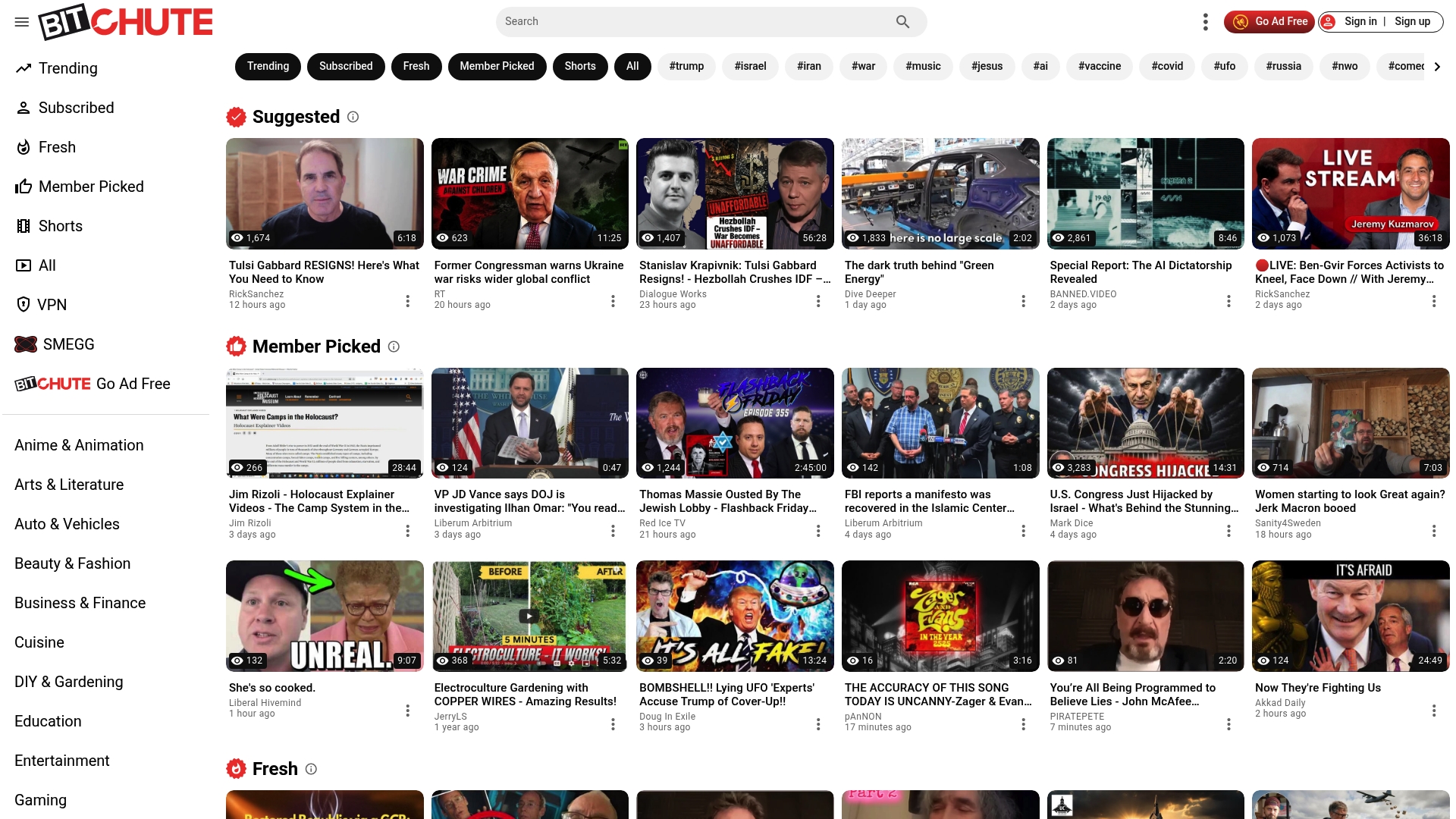
Paid memberships let viewers watch without ads while the platform foregrounds an explicit free speech posture that attracts niche and alternative creators. Discovery mixes trending, fresh, and community selections so unusual or fringe videos surface beside mainstream-style uploads.
Core Features
- Video hosting focused on niche and alternative content across news, politics, science, and entertainment.
- Trending and fresh feeds plus member-curated discovery to surface nonstandard videos and creator picks.
- Subscriptions and hashtags for audience building, plus membership tiers that include ad-free viewing and basic VPN support.
Key Differentiator
BitChute’s defining stance is its emphasis on uncensored publishing and free speech for creators who want fewer platform restrictions. That posture draws creators who prioritize direct community engagement over algorithmic amplification. Expect more editorial variance and fewer content takedowns than you see on mainstream sites.
Pros
-
Gives niche creators a place to publish material that would struggle with mainstream moderation, helping specialized communities gather in one feed.
-
Community tools like subscriptions and hashtags make it simple to build and keep an audience without complex channel programs.
-
Memberships that enable ad-free viewing provide a clear monetization path for creators and a cleaner experience for paying viewers.
-
Broad device and browser accessibility reduces friction; creators report being able to upload and share from basic setups.
Cons
-
The site is frequently associated with toxic or harmful content, which brings external scrutiny and reputation risk for creators who want a mainstream presence.
-
Moderation practices are inconsistent, so removals or reinstatements can feel arbitrary and create uncertainty for community managers.
-
Technical instability appears often in user reports, including broken account features and unreliable login flows that frustrate creators and subscribers.
-
Customer support is commonly described as slow or unhelpful when account recovery or payment issues arise.
When It May Not Fit
If you need brand-safe distribution for advertisers, predictable moderation, or stable account tools, this is likely the wrong place. Avoid BitChute when your priority is corporate partnerships, platform-level trust signals, or a support workflow that responds quickly to takedown or payment disputes.
Who It’s For
Independent creators, citizen journalists, and viewers who prioritize unfiltered perspectives and community moderation over mainstream acceptance will find BitChute useful. It suits channels that rely on direct subscriptions and niche audiences rather than ad revenue or platform-driven discovery.
Real World Use Case
An independent journalist uploads an unedited field report, tags it with topic hashtags, and notifies subscribers of the new post. The video reaches a focused community that comments and funds the creator through memberships, bypassing typical ad-revenue slowdowns.
Website: https://bitchute.com
Comparative Analysis
Public Adjusting Services Comparison
Choosing the best public adjusting service depends on factors like scope documentation, negotiation expertise, regional knowledge, and pricing alignment. Compare the options below to find a match for your specific claims needs.
| Provider | Core Feature | Key Differentiator | Best For | Notable Limitation |
|---|---|---|---|---|
| Vectorclaimsolutions | Construction-accurate damage reports | Evidence-based structured negotiation | Multi-state claims in NE, IA, CO, TX, FL | Requires clients to hire separate contractors for repair work |
| Dailymotion | Video upload and streaming platform | Combines user and professional media | Casual viewers seeking mixed content | Not a direct adjusting service—serves generic media needs |
| Rumble | Exclusive video hosting for niche creators | Platform focus on fewer restrictions | Niche creators desiring alternative outlets | Significant ad interruption affects video viewing experience |
| Nebula | Ad-free premium content platform | Creator-owned subscription model | Subscribers valuing independent content | Limited overall media library compared to mainstream alternatives |
| Odysee | Decentralized video hosting structure | Emphasizes privacy and reduced tracking | Tech-focused creators avoiding centralization | Performance and discoverability hinder consistent content access |
| BitChute | Free speech-oriented video platform | Focused on uncensored publishing | Creators and viewers in alternative niches | Reputational risks associated with toxic or harmful affiliated content |
Alternatives to YouTube and How to Protect Your Property Claims
Finding reliable YouTube alternatives can feel overwhelming given the varied content and platform stability issues discussed in this article. Whether you’re a creator struggling with unpredictable playback or a viewer seeking trustworthy sources, similar challenges of reliability and transparency also affect property insurance claims. At Vector Claim Solutions, we help homeowners and contractors in Nebraska, Iowa, Colorado, Texas, and Florida who face underpaid or delayed claims due to unclear damage scopes or low settlement offers.
Vectorclaimsolutions specializes in construction-level documentation and expert negotiation to align your insurance settlement with actual property damage. By providing clear, evidence-based reports and managing carrier communications, we reduce the financial risk and confusion often associated with insurance claims. Learn more about how we help property owners like you recover what your policy covers at Vector Claim Solutions.
Are you dealing with under scoped or denied claims?
Take control of your insurance settlement by contacting Vectorclaimsolutions today. Book a consultation to receive a detailed damage assessment and start improving your claim outcomes with expert support.
Frequently Asked Questions
What documentation does Vector Claim Solutions provide for property damage claims?
Vector Claim Solutions delivers construction-level documentation that maps physical damage to repair scope and cost. Their reports use buildable line items, which provide a detailed breakdown of necessary repairs, giving carriers clear evidence for claims. This means you can better substantiate your claim for a fair settlement.
How does Vector Claim Solutions compare to typical carrier estimates in terms of claim handling?
While typical carrier estimates may provide high-level summaries, Vector Claim Solutions independently documents damage, ensuring you have detailed line item evidence for contested scopes. This evidence-driven process minimizes delays and enhances your negotiation power with insurers, ultimately aiding in achieving a more accurate and favorable settlement.
Can I rely on Vector Claim Solutions if my insurance claim was denied or under scoped?
Vector Claim Solutions is particularly suited for property owners facing low settlement offers, as they focus on expertly documenting and negotiating claims. Their structured process interprets policy language against observed damage, which can help maximize recoveries for denied or under scoped claims. If you’ve received a low offer, engaging them can be an effective next step in your claim process.
What unique advantages does Vector Claim Solutions offer compared to traditional public adjusters?
Vector Claim Solutions employs a contingency-based fee model where fees rise only with increased settlement values. This aligns their incentives with yours—improving recovery outcomes, unlike traditional adjusters who may charge upfront fees regardless of claim results. You can have peace of mind knowing that their focus is on boosting your settlement value.
How does local knowledge benefit my claim process with Vector Claim Solutions?
Their team has regional expertise in the states of Nebraska, Iowa, Colorado, Texas, and Florida, meaning they understand local building codes and common insurer practices. This insight can help expedite the claims process and ensure your claim aligns with applicable codes, ultimately facilitating a smoother settlement.